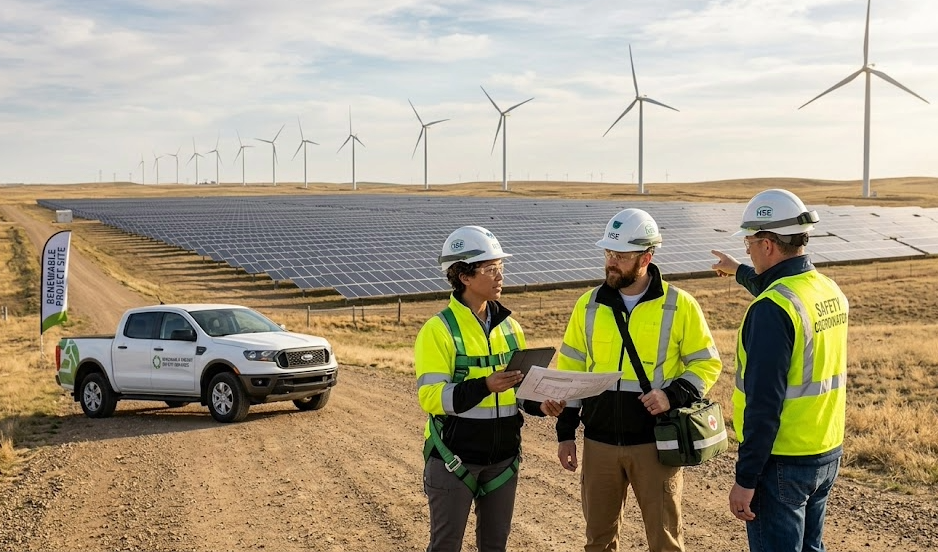
Wind farm safety services encompass comprehensive HSE support specifically designed for renewable energy projects. From on-site medical staffing to OSHA compliance frameworks, specialized renewable energy safety services address hazards unique to wind and solar construction. Most HSE firms lack actual renewables experience. Drake Group brings veteran-owned expertise with OSHA compliance, NRCME-credentialed medics, and remote site medical solutions that keep your teams protected and compliant.
Why Renewable Energy Projects Need Specialized HSE Support
The renewable energy sector is booming. Project managers in wind and solar are under immense pressure to scale operations while maintaining safety standards that are still being developed across the industry. Unlike construction or industrial plants with decades of codified safety practices, renewable energy safety remains fragmented. OSHA requirements exist, but enforcement and interpretation vary significantly.
Here’s the core problem: most HSE firms staffing projects today built their experience in traditional energy, construction, or manufacturing. They don’t understand wind turbine rescue operations, the specific hazards of elevated work on solar arrays, or the remote site logistics that define renewable projects.
The stakes are real. A fall from a 300-foot turbine tower isn’t the same as a construction site fall. Rescue operations require specialized equipment, trained personnel, and coordination with emergency services unfamiliar with industrial-scale renewable installations. Solar work on hot roofs during Texas summers demands heat illness protocols specific to photovoltaic environments. These aren’t theoretical risks; they’re operational realities that demand specialized expertise.
Rachel, the project manager at a 500-person renewable energy firm, faces a critical gap. She needs an HSE partner who understands:
- OSHA 1926 Subpart R (steel erection and related work on equipment and structures)
- ANSI/ASSP Z535 standards for hazard communication in remote locations
- Fall protection requirements specific to turbine nacelle work and solar panel installation
- Medical support protocols for sites 30+ miles from tertiary care facilities
- Confined space entry procedures in gearbox maintenance operations
- High-angle rescue procedures and coordination with local emergency services
- DC electrical hazard management in photovoltaic systems (up to 1000V in utility-scale arrays)
Renewable energy projects demand HSE providers with skin in the game. These are firms that have actually managed these hazards, not consultants applying outdated frameworks. The difference between generic HSE support and renewable-specific expertise translates directly to incident prevention, regulatory compliance, and operational efficiency.
Safety Requirements for Wind Farm Construction and Operations
Wind farm safety is multifaceted. Construction and operations phases each present distinct hazards requiring different control strategies.
During construction, the primary hazards involve:
- Struck-vi incidents from turbine components during assembly (nacelle sections weigh 200+ tons)
- Fall hazards during foundation work and turbine tower climbing
- Crane operations coordinating multiple lifts in potentially high-wind conditions
- Electrical hazards from energized transmission lines and grid interconnection
OSHA standards 1926.500 (fall protection), 1926.1400 (cranes), and 1926.960 (electrical) form the baseline. But baseline isn’t enough. Wind turbines present engineering challenges that demand site-specific safety plans, often requiring third-party review by engineers with turbine experience.
Operations phase hazards shift toward maintenance-related risks:
- Rescue operations for workers stranded in nacelles or tower sections
- Fatigue management for technicians covering multiple sites across vast service areas
- Weather-driven operational shutdowns requiring rapid communication protocols
- Blade inspection and repair work at heights exceeding 300 feet
Effective wind farm safety requires HSE providers who maintain rescue capability documentation, coordinate with local emergency services trained in high-angle rescue, and conduct ongoing competency assessments for technician teams.
References: OSHA 1926.500, 1926.1400, 1926.960; ANSI/ASSP Z590.3 (fall protection requirements for wind turbine work).
Solar Farm Safety: Unique Hazards and Staffing Needs
Solar farm projects, both utility-scale and industrial rooftop installations, present safety challenges distinct from wind operations but equally demanding.
Installation and maintenance hazards include:
- Fall protection on pitched or flat roofing surfaces during panel installation and repair
- Electrical hazards from high-voltage DC systems (up to 1000V DC in some configurations)
- Heat stress during peak summer construction in southwestern and southern states
- Ladder safety and scaffold requirements for multi-panel array work
- Arc flash hazards during inverter and combiner box maintenance
Many solar contractors operate on tight margins and tight schedules. Rachel’s team needs HSE staffing that understands solar-specific requirements without creating safety theater. These are unnecessary procedures that slow work without reducing actual risk.
Effective solar farm safety staffing requires:
- HSE coordinators trained in photovoltaic system design and failure modes
- On-site medics competent in electrical injury assessment and management
- Heat illness prevention protocols adaptive to project duration and seasonal factors
- Coordination with local utility partners for grid-tie and interconnection safety protocols
Drake Group brings this perspective: we’ve staffed utility-scale solar arrays across Texas and the Southwest, trained crews on DC electrical hazards, and managed heat-related illness prevention that doesn’t shut down projects unnecessarily.
Remote Site Medical Staffing for Energy Projects
The economic reality: on-site medical staffing costs 2-3% of total project HSE spend. For remote sites far from tertiary care, with work spanning hundreds of square miles, medical access is a defining challenge for Rachel and projects like hers.
The financial investment in on-site medical staffing returns measurable cost savings: reduced transport times for moderate injuries, immediate incident documentation, and demonstrable compliance with OSHA guidelines.
The benefit: reduced transport times for moderate injuries, immediate incident documentation meeting regulatory requirements, and demonstrable compliance with OSHA guidelines.
How to Evaluate an HSE Provider for Renewable Energy Work
Ask these specific questions:
1. How many wind turbine construction projects have you staffed? What were the cumulative turbine count and installation duration? This question cuts through the noise. A firm with real experience can cite specific projects, turbine models, and outcomes. You want specific data: 200 turbines across 12 months, named projects, quantified outcomes.
2. Do your CSP or CIH staff hold current certifications in photovoltaic system safety (PVSS)? Many HSE professionals have never studied DC electrical hazards. Ask to see active renewal documentation.
3. What’s your protocol for remote site medical coverage beyond standard occupational health? Ask for documentation of telemedicine partnerships, EMS coordination procedures, and medical supply specifications.
4. Can you provide references from renewable energy projects completed in the last 24 months? Call them yourself.
5. How do you handle safety staffing when weather forces operational shutdowns?
6. What’s your incident investigation process? A firm with real experience should discuss lessons learned and process improvements implemented.
Red flags:
- We apply the same protocols to all energy sectors
- Inability to explain DC electrical hazards or Turbine-specific rescue procedures
- Generic references from clients in unrelated industries
- No documented experience with remote site medical logistics, staff lacking current certifications or renewable-specific training
- No telemedicine or EMS coordination partnerships documented
Green flags:
- Specific project histories with documented outcomes and lessons learned
- Staff with active certifications in renewable-specific safety domains
- Proven telemedicine and EMS coordination systems with named partnerships
- Veteran-owned company culture emphasizing real-world accountability
Drake Group’s Renewable Energy Safety Experience
Drake Group LLC is veteran-owned and operates from Conroe, Texas, the heart of Texas energy country. We’ve staffed wind farm construction across West Texas and the Panhandle, managed HSE oversight on utility-scale solar arrays in South Texas. Our renewable energy HSE approach includes: On-site medical staffing with NRCME credentials, OSHA compliance frameworks updated anually, incident investigation and documentation meeting regulatory and insurance requirements. Our veteran-owned status reflects our core principle: accountability. For renewable energy projects requiring specialized HSE support, we’re ready to build your compliance framework and staff your operations.