
a woman on a phone at a wind farm job site calling someone, holder her safety helmet

Solar Farm Safety Staffing: What Developers and Contractors Need to Know

Solar farm safety staffing ensures on-site HSE and medical coverage specific to photovoltaic installation and maintenance hazards. Developers and contractors operating utility-scale or commercial rooftop solar projects need HSE coordinators trained in DC electrical systems, on-site medical personnel (NRCME-credentialed) familiar with electrical injury assessment, and heat illness protocols adaptive to construction schedules. Drake Group provides veteran-owned solar safety staffing with direct experience managing utility-scale arrays across Texas and the Southwest, delivering OSHA-compliant HSE frameworks without unnecessary safety theater.

Why Solar Farm Construction Requires Dedicated Safety Staffing

Solar farm projects operate under time and financial pressure. Developers are racing to connect utility-scale arrays to the grid while contractors manage crews spread across thousands of acres. In this environment, safety staffing often becomes an afterthought. It becomes a compliance checkbox rather than an operational asset.

Here’s the problem: generic HSE staffing doesn’t work on solar farms. Hazards in photovoltaic installation are distinct from traditional construction. High-voltage DC systems (up to 1000V in utility-scale arrays) present electrical risks most HSE professionals haven’t encountered. Heat stress on Texas rooftops during summer peaks demands protocols specific to photovoltaic environments. Fall protection on sloped solar arrays requires different strategies than roofing work.

Rachel, a project manager at a mid-sized solar developer, faces this reality on every project: she needs HSE staff who understand solar-specific risks, can coordinate with electrical crews installing combiner boxes and inverters, and can manage on-site medical response when electrical contact injuries occur. Generic HSE coordinators create friction. They slow work by applying construction frameworks that don’t fit solar operations.

The stakes are real. Electrical contact injuries in solar installations can be catastrophic. Falls from elevated arrays are compounded by harness entanglement in racking systems. Heat illness becomes life-threatening when crews work 10-hour shifts in 95-degree temperatures at 6,000+ feet elevation.

Dedicated solar safety staffing accomplishes three outcomes:

  1. Reduces incident rate through hazard recognition specific to photovoltaic systems
  2. Accelerates permitting and grid interconnection by demonstrating proactive HSE management to utility partners
  3. Protects developer and contractor liability exposure by documenting compliance with OSHA 1926 standards and ANSI/IEEE photovoltaic safety requirements

Key Hazards on Solar Farm Projects

Understanding solar-specific hazards is the foundation for staffing decisions. Each hazard category demands different expertise from HSE personnel.

Electrical Hazards: DC systems in utility-scale arrays operate at voltages (600V-1000V DC) that most electricians train to manage in AC environments. DC arc flash behaves differently than AC. The arc doesn’t self-extinguish, creating sustained burn risk. Combiner boxes, string inverters, and battery storage systems present ongoing electrical hazards during construction and maintenance. OSHA 1910.97 (electrical safety) applies, but photovoltaic-specific DC hazards require HSE staff trained in IEEE 1127 (PV systems). Many HSE firms deploy coordinators without this training, creating compliance exposure.

Fall Protection on Elevated Arrays: Ground-mounted arrays create 8-20 foot elevation changes. Rooftop installations add complexity. Pitched roofs, skylights, HVAC penetrations, and existing building infrastructure create strike hazards and anchor point challenges. OSHA 1926.500 (fall protection) is baseline, but effective fall protection on solar arrays requires HSE staff competent in:

  • Personal fall arrest system design specific to racking geometry
  • Anchor point identification and load calculation for distributed racking systems
  • Rescue procedures when workers are suspended in harnesses
  • Coordination with electricians and equipment installers working at the same elevation

Heat Stress and Environmental Factors: Solar construction concentrates during summer months when temperatures peak. Work occurs on heat-reflective surfaces (metal roofing, metal racking) that amplify ambient temperature. Workers in full PPE (hard hats, harnesses, electrical-rated clothing) face cumulative heat stress risk. OSHA guidelines recommend work-rest cycles that developers push back against due to schedule pressure. Effective heat stress management requires HSE staff who can defend science-based protocols without creating unnecessary shutdowns.

Struck-by Incidents During Equipment Installation: Panels weigh 50-80 pounds each. Racking components (rails, end caps, grounding conductors) are moved by crews coordinating across multiple installation zones simultaneously. Struck-by incidents occur when equipment falls from heights or when crew members don’t maintain adequate spacing during large component placement. HSE staff need active site presence and communication protocols to prevent these incidents.

Ladder Safety and Access Control: Solar installation is predominantly ladder-based work. Ladders are positioned on roofing, gravel surfaces, and uneven ground. Ladder safety failures compound other risks. A ladder failure at height creates a fall from elevation. HSE coordinators must conduct daily ladder safety audits, verify proper placement and securing, and enforce placement protocols even when schedule pressure builds.

OSHA Requirements for Solar Farm Construction

OSHA standards form the regulatory foundation for solar farm safety staffing. Enforcement varies by region, but federal OSHA applies to most utility-scale projects and many commercial installations.

Primary applicable standards:

OSHA 1926.500: Fall protection. Requires fall arrest systems, warning lines, guardrails, or safety nets for work at heights exceeding 6 feet. Solar installations almost always trigger this standard. HSE staff must verify fall protection compliance daily and document anchor point inspections. The challenge: solar racking creates non-standard anchor points. Generic fall protection training doesn’t prepare HSE coordinators for the geometry-specific decisions required on PV projects.

OSHA 1910.97: Electrical safety. Applies to electrical work on energized and de-energized equipment. On solar farms, this standard governs combiner box installation, inverter connections, and battery storage interfacing. Compliance requires HSE staff familiar with electrical system design and qualified electrician supervision.

OSHA 1926.95: Occupational health and environmental controls. Includes heat stress provisions that OSHA increasingly enforces. Developers facing regulatory scrutiny need HSE staffing that documents heat illness prevention protocols, work-rest cycles, and environmental monitoring.

OSHA 1926.501: Construction work. Requires site-specific safety plans addressing specific hazards present on that project. Solar farms require written plans addressing electrical hazards, fall protection on elevated arrays, heat stress protocols, and emergency response procedures specific to remote site locations.

OSHA recordkeeping: Any recordable injury (lost workday case, restricted work, or medical treatment beyond first aid) must be recorded. Electrical contact injuries and falls from height almost universally meet recordability criteria. On-site medical personnel NRCME-credentialed can manage documentation requirements and coordinate with workers’ compensation systems.

The compliance reality: OSHA standards provide minimum requirements. Utility partners (often the off-taker of solar power) frequently impose additional safety requirements through interconnection agreements. HSE staff need expertise recognizing when utility requirements exceed OSHA minimums and adapting site protocols accordingly.

How to Staff Safety and Medical Roles on Solar Projects

Effective solar farm safety staffing requires coordinated roles, each addressing specific hazards and compliance requirements. Here’s the practical breakdown:

HSE Site Coordinator: This is your primary HSE presence. The coordinator needs:

  • CSP (Certified Safety Professional) or CHST (Certified Health and Safety Technician) credential
  • Photovoltaic system design familiarity (PVSS certification preferred)
  • Fall protection competency specific to racking systems
  • Authority to halt work for safety non-compliance without schedule pushback from project management

Typical deployment: On-site 40 hours per week during construction phases. During maintenance operations, part-time or on-call deployment is often adequate depending on crew size and operational complexity.

On-Site Medical Personnel: Remote locations and electrical hazards demand immediate medical response capability. Medical staffing requires:

  • NRCME (National Registry of Certified Medical Examiners) credential, which demonstrates competency in occupational health assessment
  • Paramedic or RN background (paramedics preferred due to field medicine experience)
  • Training in electrical contact injury assessment and management
  • Telemedicine coordination capability for remote consultation

Typical deployment: 8-20 hours per week on-site depending on project size and remote location distance from emergency facilities. Projects 45+ minutes from tertiary care facilities need daily medical presence. Projects with urban proximity may sustain part-time coverage.

Electrical Safety Competent Person: For projects with high-voltage DC systems, a qualified electrician with photovoltaic safety certification provides specialized oversight:

  • Master electrician license or journeyman electrician with PV system training
  • NFPA 70E (electrical safety in the workplace) competency
  • Authority to review combiner box installation and inverter connections

Typical deployment: On-site during electrical commissioning phases. On some projects, contracted part-time from the electrical contractor’s crew.

Emergency Action Plan Coordinator: Every solar project needs documented emergency response protocols including:

  • Site-specific EMS communication protocols
  • Helicopter evacuation procedures for remote projects
  • Medical supply caches appropriate to project location and distance from advanced medical care
  • Incident command structure and notification procedures

Typical deployment: 20-40 hours during project startup to develop and train emergency procedures. Ongoing oversight during operations.

Staffing cost considerations: A fully staffed HSE team for a utility-scale solar project (100+ MW( typically costs 2-4% of total project HSE budget. This investment delivers regulatory compliance, incident prevention, and reduced liability exposure that far exceed staffing costs through avoided incidents and improved project reputation.

Frequently Asked Questions

1. Solar farm safety staffing requirements

OSHA mandates site-specific safety plans addressing fall protection, electrical hazards, and heat stress. Staffing must include an HSE coordinator (CSP or CHST), electrically competent personnel for combiner box and inverter installation, and on-site medical coverage for remote locations. Specific requirements depend on project size, location, and electrical system complexity. Drake Group assesses each project individually to determine staffing levels that meet regulatory requirements without unnecessary overhead.

2. Do solar farms need on-site medics?

On-site medical personnel are operationally essential for solar projects, especially utility-scale installations in remote locations. Electrical contact injuries and falls from elevated arrays demand immediate assessment and intervention. OSHA doesn’t mandate on-site medics, but projects 45+ minutes from emergency departments need daily NRCME-credentialed coverage. Drake Group deploys medical personnel trained in electrical injury assessment and remote site protocols, coordinating directly with local EMS for site-specific emergency action plans.

3. What are renewable energy safety requirements?

Renewable energy projects (wind, solar, battery storage) must comply with OSHA construction standards (1926 series) including fall protection, electrical safety, and occupational health provisions. Additional requirements come from ANSI/IEEE photovoltaic safety standards, utility interconnection agreements, and state-specific regulations. Effective compliance requires HSE providers with renewable-specific expertise. Generic construction HSE doesn’t address wind turbine rescue operations or DC electrical hazards unique to solar installations. Drake Group specializes in renewable-specific requirements.

4. Compare safety staffing agencies for renewable energy

Credible renewable energy HSE providers distinguish themselves by demonstrating actual project experience, not just certification credentials. Ask prospective agencies: How many utility-scale solar projects have you staffed? What’s your NRCME medical staff credential status? Can you provide three recent project references? Most traditional HSE firms lack renewable-specific expertise. Drake Group’s veteran ownership and direct renewable energy project experience positions us differently. We manage safety staffing as operational partners, not compliance vendors.

5. How much does on-site medical staffing cost?

On-site medical staffing for solar projects typically costs $3,000-8,000 per week depending on location, required credential level (NRCME vs. standard occupational health), and deployment intensity. Utility-scale projects deploying daily coverage across 6-12 month construction phases typically budget $100,000-250,000 for medical staffing. Cost-benefit analysis shows this investment prevents transport delays for moderate injuries, ensures OSHA-compliant incident documentation, and reduces overall project risk. Drake Group provides transparent cost modeling specific to your project scope and location.

Ready to Staff Your Solar Project HSE Team?

Request a solar project HSE staffing quote from Drake Group. We provide OSHA-compliant safety coordination, NRCME-credentialed medical personnel, and electrical safety oversight specific to utility-scale photovoltaic installations. Contact us for a project assessment.

Solar Farm Safety Staffing: What Developers and Contractors Need to Know Read More »
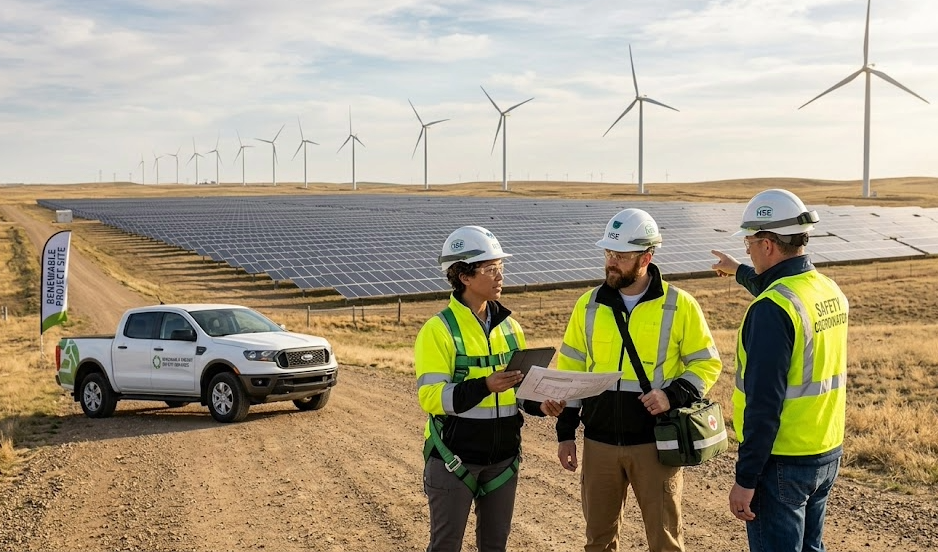
sustainability solar and wind turbines

Renewable Energy Safety Services: What Wind and Solar Projects Need in 2026

Wind farm safety services encompass comprehensive HSE support specifically designed for renewable energy projects. From on-site medical staffing to OSHA compliance frameworks, specialized renewable energy safety services address hazards unique to wind and solar construction. Most HSE firms lack actual renewables experience. Drake Group brings veteran-owned expertise with OSHA compliance, NRCME-credentialed medics, and remote site medical solutions that keep your teams protected and compliant.

Why Renewable Energy Projects Need Specialized HSE Support

The renewable energy sector is booming. Project managers in wind and solar are under immense pressure to scale operations while maintaining safety standards that are still being developed across the industry. Unlike construction or industrial plants with decades of codified safety practices, renewable energy safety remains fragmented. OSHA requirements exist, but enforcement and interpretation vary significantly.

Here’s the core problem: most HSE firms staffing projects today built their experience in traditional energy, construction, or manufacturing. They don’t understand wind turbine rescue operations, the specific hazards of elevated work on solar arrays, or the remote site logistics that define renewable projects.

The stakes are real. A fall from a 300-foot turbine tower isn’t the same as a construction site fall. Rescue operations require specialized equipment, trained personnel, and coordination with emergency services unfamiliar with industrial-scale renewable installations. Solar work on hot roofs during Texas summers demands heat illness protocols specific to photovoltaic environments. These aren’t theoretical risks; they’re operational realities that demand specialized expertise.

Rachel, the project manager at a 500-person renewable energy firm, faces a critical gap. She needs an HSE partner who understands:

  • OSHA 1926 Subpart R (steel erection and related work on equipment and structures)
  • ANSI/ASSP Z535 standards for hazard communication in remote locations
  • Fall protection requirements specific to turbine nacelle work and solar panel installation
  • Medical support protocols for sites 30+ miles from tertiary care facilities
  • Confined space entry procedures in gearbox maintenance operations
  • High-angle rescue procedures and coordination with local emergency services
  • DC electrical hazard management in photovoltaic systems (up to 1000V in utility-scale arrays)

Renewable energy projects demand HSE providers with skin in the game. These are firms that have actually managed these hazards, not consultants applying outdated frameworks. The difference between generic HSE support and renewable-specific expertise translates directly to incident prevention, regulatory compliance, and operational efficiency.

Safety Requirements for Wind Farm Construction and Operations

Wind farm safety is multifaceted. Construction and operations phases each present distinct hazards requiring different control strategies.

During construction, the primary hazards involve:

  • Struck-vi incidents from turbine components during assembly (nacelle sections weigh 200+ tons)
  • Fall hazards during foundation work and turbine tower climbing
  • Crane operations coordinating multiple lifts in potentially high-wind conditions
  • Electrical hazards from energized transmission lines and grid interconnection

OSHA standards 1926.500 (fall protection), 1926.1400 (cranes), and 1926.960 (electrical) form the baseline. But baseline isn’t enough. Wind turbines present engineering challenges that demand site-specific safety plans, often requiring third-party review by engineers with turbine experience.

Operations phase hazards shift toward maintenance-related risks:

  • Rescue operations for workers stranded in nacelles or tower sections
  • Fatigue management for technicians covering multiple sites across vast service areas
  • Weather-driven operational shutdowns requiring rapid communication protocols
  • Blade inspection and repair work at heights exceeding 300 feet

Effective wind farm safety requires HSE providers who maintain rescue capability documentation, coordinate with local emergency services trained in high-angle rescue, and conduct ongoing competency assessments for technician teams.

References: OSHA 1926.500, 1926.1400, 1926.960; ANSI/ASSP Z590.3 (fall protection requirements for wind turbine work).

Solar Farm Safety: Unique Hazards and Staffing Needs

Solar farm projects, both utility-scale and industrial rooftop installations, present safety challenges distinct from wind operations but equally demanding.

Installation and maintenance hazards include:

  • Fall protection on pitched or flat roofing surfaces during panel installation and repair
  • Electrical hazards from high-voltage DC systems (up to 1000V DC in some configurations)
  • Heat stress during peak summer construction in southwestern and southern states
  • Ladder safety and scaffold requirements for multi-panel array work
  • Arc flash hazards during inverter and combiner box maintenance

Many solar contractors operate on tight margins and tight schedules. Rachel’s team needs HSE staffing that understands solar-specific requirements without creating safety theater. These are unnecessary procedures that slow work without reducing actual risk.

Effective solar farm safety staffing requires:

  • HSE coordinators trained in photovoltaic system design and failure modes
  • On-site medics competent in electrical injury assessment and management
  • Heat illness prevention protocols adaptive to project duration and seasonal factors
  • Coordination with local utility partners for grid-tie and interconnection safety protocols

Drake Group brings this perspective: we’ve staffed utility-scale solar arrays across Texas and the Southwest, trained crews on DC electrical hazards, and managed heat-related illness prevention that doesn’t shut down projects unnecessarily.

Remote Site Medical Staffing for Energy Projects

The economic reality: on-site medical staffing costs 2-3% of total project HSE spend. For remote sites far from tertiary care, with work spanning hundreds of square miles, medical access is a defining challenge for Rachel and projects like hers.

The financial investment in on-site medical staffing returns measurable cost savings: reduced transport times for moderate injuries, immediate incident documentation, and demonstrable compliance with OSHA guidelines.

The benefit: reduced transport times for moderate injuries, immediate incident documentation meeting regulatory requirements, and demonstrable compliance with OSHA guidelines.

How to Evaluate an HSE Provider for Renewable Energy Work

Ask these specific questions:

1. How many wind turbine construction projects have you staffed? What were the cumulative turbine count and installation duration? This question cuts through the noise. A firm with real experience can cite specific projects, turbine models, and outcomes. You want specific data: 200 turbines across 12 months, named projects, quantified outcomes.

2. Do your CSP or CIH staff hold current certifications in photovoltaic system safety (PVSS)? Many HSE professionals have never studied DC electrical hazards. Ask to see active renewal documentation.

3. What’s your protocol for remote site medical coverage beyond standard occupational health? Ask for documentation of telemedicine partnerships, EMS coordination procedures, and medical supply specifications.

4. Can you provide references from renewable energy projects completed in the last 24 months? Call them yourself.

5. How do you handle safety staffing when weather forces operational shutdowns?

6. What’s your incident investigation process? A firm with real experience should discuss lessons learned and process improvements implemented.

Red flags:

  • We apply the same protocols to all energy sectors
  • Inability to explain DC electrical hazards or Turbine-specific rescue procedures
  • Generic references from clients in unrelated industries
  • No documented experience with remote site medical logistics, staff lacking current certifications or renewable-specific training
  • No telemedicine or EMS coordination partnerships documented

Green flags:

  • Specific project histories with documented outcomes and lessons learned
  • Staff with active certifications in renewable-specific safety domains
  • Proven telemedicine and EMS coordination systems with named partnerships
  • Veteran-owned company culture emphasizing real-world accountability

Drake Group’s Renewable Energy Safety Experience

Drake Group LLC is veteran-owned and operates from Conroe, Texas, the heart of Texas energy country. We’ve staffed wind farm construction across West Texas and the Panhandle, managed HSE oversight on utility-scale solar arrays in South Texas. Our renewable energy HSE approach includes: On-site medical staffing with NRCME credentials, OSHA compliance frameworks updated anually, incident investigation and documentation meeting regulatory and insurance requirements. Our veteran-owned status reflects our core principle: accountability. For renewable energy projects requiring specialized HSE support, we’re ready to build your compliance framework and staff your operations.

Renewable Energy Safety Services: What Wind and Solar Projects Need in 2026 Read More »

two people speaking baout safety on a construction oil site

Evaluating HSE Service Providers in 2026: What Industrial Operators Should Actually Look For

When an HSE services contract comes up for renewal, most industrial operators start with the name they already know. But a growing number of procurement and safety leaders are looking beyond familiar brands, driven by slow response times, rigid service structures, and customer satisfaction records that have drawn scrutiny across industry review platforms.

This guide breaks down what to evaluate when comparing HSE service providers, what gaps operators commonly experience with large national firms, and how to identify a partner that actually fits your project’s operational reality.

Why Operators Are Reevaluating Their HSE Partners

Brand recognition and service delivery quality are not the same thing. Public review data on platforms like Comparably shows that some of the most recognized names in industrial safety services carry Net Promoter Scores well below zero and customer satisfaction ratings that would be unacceptable in most professional service sectors.

The patterns these reviews describe are consistent: slow mobilization to remote sites, account management layers that delay decision-making, and one-size-fits-all service packages that do not flex to project-specific requirements.

For operators managing TRIR targets, ISNetworld compliance deadlines, and project timelines measured in weeks rather than quarters, these gaps create real operational risk.

The Problem With Single-Source Safety Vendors

Large national HSE firms built their market position through decades of brand-building and acquisition. Over time, many have consolidated into single-source vendors who bundle services together in fixed tiers, with account management structures designed for enterprise clients rather than mid-market contractors.

The operational reality for most industrial operators is that these structures create friction. The larger the firm, the more layers between your project and a decision. Mobilization timelines are quoted in weeks because staffing involves a recruiting cycle, not a bench of pre-qualified personnel. Service packages include things you do not need and lack flexibility for things specific to your project.

Understanding this dynamic helps clarify what to look for in an alternative: a provider with demonstrated bench depth, credential verification at the individual level, and contract structures that scope to your project rather than fitting your project into their predetermined tiers.

What to Evaluate in Any HSE Service Provider

Whether you are switching providers or evaluating one for the first time, these five categories should drive your assessment.

First, credential depth across your required disciplines. A provider staffing safety technicians should employ personnel holding CSP, CHST, or equivalent certifications. Medical staffing should include NRCME-certified examiners, CAOHC-certified audiometric technicians, and providers with case management credentials like ATC, CES, or CRIS.

Second, mobilization speed. Ask for documented deployment timelines on recent projects. The difference between a 48-hour mobilization and a two-week onboarding cycle can determine whether your project stays on schedule.

Third, ISNetworld and Avetta scores. Request current scores and ask how they maintain compliance across multiple platforms simultaneously. A provider with strong scores on one platform but no presence on another creates compliance gaps.

Fourth, integrated service capability. Projects increasingly require medical, safety, environmental, and security services under a single contract. Providers who can deliver all four through one mobilization, one point of contact, and one invoice reduce your administrative burden and eliminate coordination gaps between subcontractors.

Fifth, contract flexibility. Large national firms typically offer fixed service tiers. Ask whether the provider will scope services to your specific project parameters, including headcount, duration, site conditions, and regulatory environment.

The Single-Contract Advantage

One of the most significant operational improvements operators report when switching providers is the move from managing four or five separate HSE subcontracts to a single integrated agreement.

When medical staffing, safety oversight, environmental compliance, and site security all operate under separate contracts with separate vendors, coordination failures are inevitable. Incident response protocols conflict. Reporting formats differ. And when something goes wrong on site, accountability becomes a finger-pointing exercise between vendors.

Integrated providers eliminate this. A single contract means unified incident reporting, coordinated emergency response protocols, and one account manager who owns the entire HSE scope.

Why Veteran-Owned HSE Firms Operate Differently

Veteran-owned firms bring operational discipline that translates directly to HSE service delivery. Military-trained leadership understands chain of command, rapid deployment logistics, and operating in austere environments with limited infrastructure.

This is not a marketing differentiator. It is an operational one. When a client needs qualified HSE personnel on a remote pipeline right-of-way in West Texas within 48 hours, the provider’s ability to mobilize under pressure determines whether the project stays on schedule.

How Drake Group Approaches HSE Service Delivery

Drake Group LLC is a veteran-owned occupational health, safety, environmental, and security services company headquartered in Conroe, Texas. The company operates through two primary divisions: Drake Occupational Health and Safety, covering medical staffing, safety oversight, DOT compliance, and case management, and Global Risk Solutions Group, covering site security and risk mitigation.

Drake’s model is built around the integrated single-contract approach. One mobilization, one point of contact, one set of compliance credentials across ISNetworld, Avetta, and Veriforce.

Frequently Asked Questions

Q: What should I look for when evaluating HSE service providers?
A: Evaluate providers on five categories: credential depth across required disciplines, documented mobilization timelines, current ISNetworld and Avetta scores, integrated service capability across medical, safety, environmental, and security, and contract flexibility to scope services to your specific project.

Q: What is an integrated HSE services contract?
A: An integrated HSE services contract covers medical staffing, safety oversight, environmental compliance, and site security under a single agreement with one provider. This eliminates coordination gaps between multiple subcontractors and simplifies compliance reporting, incident management, and invoicing.

Q: Does Drake Group hold ISNetworld and Avetta compliance?
A: Drake Group maintains active compliance credentials across ISNetworld, Avetta, and Veriforce. Safety and medical personnel hold current certifications including CSP, NRCME, CAOHC, ATC, CES, and CRIS.

Ready to evaluate your HSE provider options? Contact Drake Group for a capabilities overview.

Evaluating HSE Service Providers in 2026: What Industrial Operators Should Actually Look For Read More »

Scroll to Top