Rapid-response HSE team of three professionals in FR coveralls and high-visibility vests at a remote wellsite gate at dawn, unloading an AED, medical gear, and safety equipment from a crew-cab pickup truck and medical unit trailer.

Emergency HSE Staffing: How to Deploy Qualified Safety Personnel in 48 Hours

Emergency HSE staffing situations happen more often than anyone plans for. A provider no-shows on mobilization day. A safety technician has a family emergency mid-project. An operator audit finds your HSE coverage inadequate and gives you 48 hours to fix it. A fast-tracked project kicks off two weeks ahead of schedule.

Why Emergency HSE Staffing Situations Occur

Provider failure is the most common cause. A staffing company commits to a mobilization date and misses it because they were recruiting after contract award rather than pulling from a pre-qualified bench. Project acceleration occurs when construction schedules move up and the HSE provider cannot compress their deployment process. Operator audit findings sometimes require immediate staffing increases. Mid-project personnel changes happen when a deployed safety technician leaves for any reason.

What 48-Hour Deployment Actually Requires

First, the provider needs a bench of pre-qualified personnel who are not currently deployed. Providers operating at 100 percent utilization have no bench capacity for emergency requests. Second, credential packages must be current and ready. A 48-hour timeline does not allow for renewed certifications, updated background checks, or new drug tests. Third, deployment logistics for the specific geographic region must be handled within the 48-hour window. Fourth, the deployed professional must be operationally effective on arrival, not just physically present.

How to Evaluate Emergency Staffing Capability Before You Need It

The time to evaluate a provider’s emergency capability is before you have an emergency. Ask specifically how many pre-qualified, non-deployed safety professionals they have available in your operating region. Ask for examples of recent emergency deployments with specific timelines. Some contractors maintain standing agreements with emergency staffing providers. A pre-negotiated rate and mobilization commitment that can be activated with a single phone call.

The Cost of Not Having Emergency Coverage

A project operating without required HSE coverage faces immediate compliance risk. If an incident occurs without a qualified safety professional on site, the liability and TRIR implications are severe. Crew idle time costs money directly. If work must stop because safety personnel are unavailable, every hour of idle crew time and equipment rental is a direct cost attributable to the staffing gap.

Frequently Asked Questions

Q: How fast can emergency HSE staffing be deployed?
A: Providers with pre-qualified bench personnel can typically deploy to established operating regions within 24 to 48 hours. Providers who need to recruit after receiving the request typically require one to two weeks.

Q: What should I do if my HSE provider no-shows on mobilization day?
A: Contact your backup HSE staffing provider immediately. Notify the operator and provide a replacement timeline. Do not allow work to proceed without required safety coverage.

Need qualified HSE personnel on site fast? Drake Group maintains pre-qualified bench personnel ready for 48-hour deployment across Gulf Coast, Permian Basin, and Appalachian operating regions. Contact us for emergency staffing availability.

Emergency HSE Staffing: How to Deploy Qualified Safety Personnel in 48 Hours Read More »

HSE advisor in high-visibility vest conducting a job hazard analysis with two craft workers at a petrochemical construction site, pointing out an overhead hazard near scaffolding during active work.

What Does an HSE Advisor Actually Do on a Construction Site?

An HSE advisor on a construction site is responsible for identifying and eliminating hazards before they cause injuries, ensuring the project complies with OSHA regulations and operator requirements, and creating the conditions where workers go home in the same condition they arrived.

The Morning: Pre-Task Planning and Hazard Identification

Before any tools come out, the HSE advisor reviews the day’s work scope and conducts or oversees pre-task hazard assessments, commonly called Job Safety Analyses or JHAs. Pre-task planning is not a formality. It is the primary mechanism for identifying hazards before work begins. The advisor walks the work areas, reviews planned activities against the site-specific safety plan, and identifies any conditions that have changed since the previous shift.

Throughout the Day: Safety Observations and Field Presence

The core of the HSE advisor’s day is spent in the field, not in a trailer. The most effective advisors approach observations as coaching opportunities. When they observe an at-risk behavior, they stop the work, discuss the hazard with the worker, and help them identify a safer approach. This coaching model builds safety awareness across the crew rather than creating a dynamic where workers hide unsafe practices when the safety person is watching.

Incident Response and Investigation

When an incident occurs, the HSE advisor ensures the injured worker receives appropriate medical attention, secures the incident scene, notifies the project superintendent, and initiates the incident investigation. A thorough investigation identifies root causes, the systemic factors that allowed the incident to occur. An HSE advisor who only documents what happened without identifying why it happened is not completing the investigation.

Compliance Documentation and Reporting

The less visible but equally important part of the role is maintaining compliance documentation: daily safety observation logs, incident and near-miss reports, permit-to-work documentation, equipment inspection records, and training documentation. This documentation is also the evidence base for your OSHA 300 Log entries and TRIR calculation.

Frequently Asked Questions

Q: What certifications does an HSE advisor need?
A: The most recognized certifications are CSP from the Board of Certified Safety Professionals and CHST for construction-specific positions. OSHA 30-hour training is a common baseline requirement.

Q: How many HSE advisors does a construction project need?
A: Common ratios range from one advisor per 50 to 75 workers on general construction to one per 25 to 40 on high-hazard operations. Operators may specify minimum ratios in their contract requirements.

Q: What safety certifications are required for oil and gas work?
A: Oil and gas projects typically require CSP or CHST, OSHA 30-hour training, H2S awareness, HAZWOPER certification, and PEC SafeLand or equivalent orientation training.

Need a qualified HSE advisor for your next project? Contact Drake Group for staffing availability.

What Does an HSE Advisor Actually Do on a Construction Site? Read More »

HSE manager completing OSHA incident recordkeeping at a dual-monitor workstation in a job site office, with an industrial facility visible through the window at dusk, hard hat and safety glasses resting on the desk.

OSHA Recordkeeping Requirements for Contractors: Avoiding the Most Common Mistakes

OSHA recordkeeping is the compliance requirement that every contractor knows about and a surprising number get wrong. The mistakes are rarely dramatic. They are subtle classification errors, missed recording deadlines, and log maintenance oversights that compound into citation exposure, ISNetworld findings, and inaccurate TRIR calculations.

Which Contractors Must Keep OSHA Records

OSHA recordkeeping requirements under 29 CFR Part 1904 apply to most employers. Employers with 10 or fewer employees are exempt from routine recordkeeping, but most oil and gas, pipeline, construction, and industrial services contractors exceed the 10-employee threshold. Even if your company qualifies for a partial exemption, operators require OSHA logs as part of their ISNetworld, Avetta, or direct prequalification requirements.

The OSHA 300 Log: What Must Be Recorded

A case is recordable if it results in death, days away from work, restricted work, medical treatment beyond first aid, loss of consciousness, or a significant injury diagnosed by a licensed healthcare professional. The distinction between first aid and medical treatment is where most classification errors occur. Prescription-strength medications, sutures, and physical therapy all constitute medical treatment that makes a case recordable.

Recording Deadlines and Log Maintenance

New cases must be entered on the 300 Log within seven calendar days. OSHA 300 Logs must be kept for five years following the year they cover. The 300A summary must be posted from February 1 through April 30 each year and must be certified by a company executive.

How Recordkeeping Errors Affect Your TRIR and ISNetworld

ISNetworld’s RAVS review process independently evaluates your OSHA logs, and discrepancies between your reported rates and the underlying log data trigger compliance findings. Under-recording creates citation exposure and ISNetworld audit risk. Over-recording inflates your TRIR relative to your actual safety performance.

Frequently Asked Questions

Q: What OSHA forms do contractors need to keep?
A: Most contractors must maintain the OSHA 300 Log, the OSHA 300A Summary, and the OSHA 301 Incident Report for each recordable case. These forms must be kept for five years.

Q: What is the difference between OSHA first aid and medical treatment?
A: First aid is a specific list of minor treatments. Any treatment beyond the first aid list, including prescription medications, sutures, and physical therapy, constitutes medical treatment and makes the case recordable.

Q: When do OSHA 300 Logs need to be updated?
A: New cases must be entered within seven calendar days. Electronic submission through the ITA system is due by March 2 for qualifying employers.

Need help ensuring your OSHA recordkeeping is audit-ready? Contact Drake Group for a compliance review.

OSHA Recordkeeping Requirements for Contractors: Avoiding the Most Common Mistakes Read More »

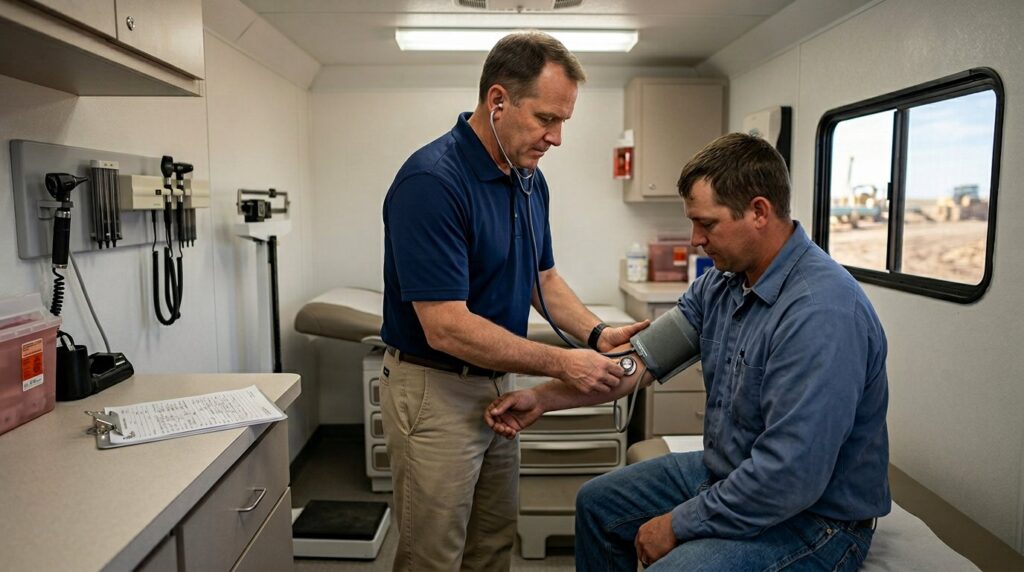
NRCME-certified medical examiner performing a DOT physical on a seated worker inside a mobile medical unit trailer at a remote pipeline project site, taking blood pressure with a manual cuff and stethoscope.

Pre-Employment Drug Testing and DOT Physicals: What Contractors Need to Know

Pre-employment drug testing and DOT physical examinations are foundational compliance requirements for contractors in oil and gas, pipeline, construction, and transportation. Getting them wrong creates immediate project access problems, regulatory exposure, and potential disqualification from operator work scopes.

DOT Physical Examination Requirements

The DOT physical examination is required for all commercial motor vehicle drivers under FMCSA regulations. The certificate is valid for up to 24 months. The critical compliance point: since 2014, DOT physicals must be performed by medical examiners listed on the FMCSA National Registry of Certified Medical Examiners. A physical performed by a provider not on the NRCME registry is invalid for DOT purposes, regardless of the provider’s medical qualifications. This is the single most common DOT physical audit finding.

NRCME Medical Examiner Requirements

Contractors should verify their medical provider’s NRCME listing before scheduling any DOT physical. The FMCSA maintains a public search tool where you can confirm a provider’s current registry status. Using a non-listed provider means every driver physical performed by that provider is invalid, which can cascade into driver qualification file deficiencies across your entire fleet.

Drake Group’s clinical operations team includes NRCME-certified medical examiners who can perform DOT physicals on site at project locations, eliminating the need for drivers to travel to off-site clinics.

Pre-Employment Drug Testing Requirements

For DOT-regulated positions, pre-employment drug testing must follow 49 CFR Part 40 procedures. The DOT five-panel test screens for marijuana, cocaine, opiates, amphetamines, and phencyclidine. For PHMSA-regulated pipeline operations, testing must be completed with a verified negative result before any individual performs a covered pipeline function. The most common pre-employment testing mistake is timing. Verify the acceptable testing window for each operator before assuming a previous test result remains valid.

Audiometric Testing and Hearing Conservation

Contractors with employees exposed to noise levels at or above 85 decibels over an eight-hour time-weighted average must implement a hearing conservation program under OSHA 29 CFR 1910.95. Audiometric testing must be performed by a CAOHC-certified technician or a licensed audiologist. Drake Group’s clinical team includes CAOHC-certified technicians who can conduct audiometric testing on site.

Frequently Asked Questions

Q: Who can perform a DOT physical examination?
A: DOT physicals must be performed by a medical examiner listed on the FMCSA National Registry of Certified Medical Examiners. Physicals performed by non-NRCME providers are invalid for DOT purposes.

Q: What does a DOT drug test screen for?
A: The DOT five-panel drug test screens for marijuana, cocaine, opiates, amphetamines, and phencyclidine. Testing must follow 49 CFR Part 40 procedures using SAMHSA-certified laboratories.

Q: Can DOT physicals be done on site at project locations?
A: Yes, if the on-site medical provider holds current NRCME certification. Drake Group provides NRCME-certified examiners as part of its on-site medical staffing services.

Need on-site DOT physicals, drug testing, or audiometric services? Contact Drake Group for medical staffing capabilities.

Pre-Employment Drug Testing and DOT Physicals: What Contractors Need to Know Read More »

Client project manager shaking hands with an HSE services contractor at a refinery gate at golden hour, with a credentialed multi-discipline safety and medical team standing by with gear bags ready to deploy.

What to Look for in an HSE Staffing Partner for Oil and Gas Projects

The HSE staffing partner you choose for oil and gas projects directly determines your safety performance, compliance posture, and ability to meet operator prequalification requirements. A strong partner strengthens your TRIR, simplifies ISNetworld compliance, and deploys qualified personnel fast enough to keep your project on schedule.

Why HSE Staffing Decisions Matter More in Oil and Gas

Operators set explicit TRIR and DART thresholds for contractor prequalification. ISNetworld scores are visible to every potential client reviewing your profile. And a single serious incident on a high-profile project can affect your bidding eligibility across an entire basin. The difference between a qualified HSE staffing partner and a generic staffing agency is not a matter of preference. It is a matter of business continuity.

Credential Depth Across Disciplines

Safety professionals should hold CSP, CHST, or OHST certifications from the Board of Certified Safety Professionals. Medical staffing should include NRCME-certified medical examiners for DOT physicals, CAOHC-certified technicians for audiometric testing, and personnel with case management credentials for return-to-work programs. Environmental personnel should understand SPCC plan requirements, stormwater management, and air quality monitoring for H2S and VOC exposure.

The Integration Advantage

When an incident occurs on site, the safety technician, medical provider, environmental response team, and security personnel all need to operate from the same emergency action plan. If they work for four different companies with four different reporting structures, coordination failures are not a possibility. They are a certainty. Integrated HSE providers deliver all four disciplines under a single contract with a unified chain of command.

Rapid Deployment and Bench Depth

Evaluate providers on their bench depth: the number of pre-qualified, pre-credentialed personnel available for immediate deployment. A provider who needs to recruit for your position after you award the contract is a provider who will delay your project. Ask about deployment logistics for your specific operating area. Geographic alignment between the provider’s available personnel and your project location is critical.

Contract Flexibility and Red Flags

Red flags to watch for: a provider who cannot tell you which certifications their personnel hold without checking does not have a credential management system. A provider who refuses to share ISNetworld or Avetta scores likely has compliance issues they are not disclosing. A provider who cannot produce references from comparable projects within the past 12 months may not have the relevant experience they claim.

Frequently Asked Questions

Q: What does HSE staffing include for oil and gas?
A: HSE staffing for oil and gas typically includes safety technicians and managers, occupational health and medical personnel, environmental compliance specialists, and industrial hygienists. Comprehensive providers also include site security and emergency response personnel.

Q: Can one provider handle medical, safety, and environmental?
A: Yes. Integrated HSE providers deliver medical staffing, safety oversight, environmental compliance, and site security under a single contract. Not all providers offer true integration, so verify their capability across all required disciplines.

Looking for an integrated HSE staffing partner? Contact Drake Group for a capabilities overview.

What to Look for in an HSE Staffing Partner for Oil and Gas Projects Read More »

DOT-qualified pipeline safety observer in FR coveralls with clipboard standing alongside an active pipeline construction right-of-way, with sidebooms lowering coated steel pipe into a trench in red-clay terrain.

DOT Compliance Checklist for Pipeline Construction Contractors in 2026

DOT compliance for pipeline construction contractors covers a specific set of federal requirements under PHMSA and FMCSA regulations. Missing any single element can result in project shutdowns, operator penalties, and contractor disqualification from future work.

Pre-Project Documentation Requirements

Operator qualification records must be current under 49 CFR Part 192 for gas pipelines and Part 195 for hazardous liquid pipelines. Every individual performing covered tasks must have documented qualification for each specific task. Qualification is task-specific, not role-specific.

Drug and alcohol program documentation must demonstrate compliance with 49 CFR Part 199 for pipeline operators and Part 40 for testing procedures. Damage prevention plans must comply with state one-call requirements and federal requirements.

Driver Qualification File Requirements

Every CMV driver must have a complete Driver Qualification file under FMCSA Part 391. Required elements include a completed employment application going back 10 years, motor vehicle records, road test certificate, annual driving record review, and a medical examiner’s certificate from an NRCME-listed provider.

The NRCME requirement is the most common audit finding. Certificates from non-listed providers are not valid for DOT purposes.

Hours of Service Rules on Pipeline Projects

The standard rules limit property-carrying CMV drivers to 11 hours of driving after 10 consecutive hours off duty, with a 14-hour on-duty window. Pipeline construction projects may qualify for certain exemptions, but assuming an exemption applies without verifying the criteria is a common compliance failure. Electronic logging devices are required for most CMV operations.

Drug and Alcohol Testing Requirements

Random testing must be conducted at the minimum annual rates set by PHMSA: 50 percent for drug testing and 10 percent for alcohol testing. All testing must use certified laboratories and follow DOT-specified chain-of-custody procedures under Part 40.

The Cost of Non-Compliance

FMCSA civil penalties can reach over $16,000 per violation. PHMSA penalties for pipeline safety violations can exceed $200,000 per violation per day. Beyond direct penalties, non-compliance creates cascading consequences including project suspension and ISNetworld compliance findings.

Frequently Asked Questions

Q: What DOT regulations apply to pipeline construction?
A: Pipeline construction contractors must comply with PHMSA regulations under 49 CFR Parts 192 and 195, FMCSA regulations under Parts 382, 383, 391, 395, and 396, and Part 199 for drug and alcohol testing.

Q: What is operator qualification for pipeline work?
A: Operator qualification requires that every individual performing a covered task be specifically qualified for that task through evaluation, training, and documentation. Qualification is task-specific.

Need DOT compliance support for your pipeline project? Contact Drake Group for comprehensive DOT compliance services including NRCME-certified medical examinations.

DOT Compliance Checklist for Pipeline Construction Contractors in 2026 Read More »

Contractor compliance coordinator working at a laptop in a job site office trailer, managing ISNetworld and Avetta prequalification documentation with file folders, notebook, and hard hat nearby.

ISNetworld vs Avetta vs Veriforce: What Operators Actually Require

ISNetworld, Avetta, and Veriforce are the three dominant contractor management platforms used by operators in oil and gas, pipeline, mining, construction, and energy. Each platform collects and verifies contractor safety data, insurance documentation, and compliance records, but they differ in how they score contractors, what documentation they require, and which operators mandate which platform.

What ISNetworld Requires

ISNetworld is the most widely used contractor management platform in North America, particularly in oil and gas and petrochemical operations. Core requirements include your OSHA 300 logs and incident rates for the past three years, your Experience Modification Rate, a written health and safety program, insurance certificates, and employee training records. ISNetworld assigns a grade to each submitted element. Maintaining an A or B grade across all categories is effectively required to remain eligible for work with most major operators.

What Avetta Requires

Avetta serves a broader industry range than ISNetworld, with strong adoption in construction, manufacturing, utilities, and mining. Avetta uses a compliance scoring system that evaluates your documentation against the specific requirements set by each operator you connect with. One notable difference is that Avetta’s operator-specific requirements can vary more widely than ISNetworld’s standardized RAVS categories.

What Veriforce Requires

Veriforce is heavily used in pipeline operations and is the dominant platform for DOT-regulated contractor prequalification. Veriforce focuses heavily on operator qualification records under 49 CFR Part 192 and 195, drug and alcohol testing program compliance, and safety performance metrics specific to pipeline operations. Qualification records must be maintained at the individual employee and task level.

Managing Compliance Across All Three Simultaneously

The most efficient approach treats the three platforms as variations on a single compliance program. Build your safety management system and documentation standards to the highest common denominator across all three. Designate a single compliance coordinator responsible for all three platforms. Maintain a master document library and update all three platforms simultaneously when documents change.

How Your HSE Staffing Partner Affects Platform Compliance

Your HSE staffing partner’s compliance status on these platforms directly affects your own compliance profile. Before engaging any HSE staffing partner, verify their current compliance status on every platform your operators require. Ask for current scores, not just confirmation of enrollment.

Frequently Asked Questions

Q: Do I need ISNetworld and Avetta and Veriforce?
A: It depends on which operators you work for. Pipeline contractors almost always need Veriforce. Oil and gas contractors typically need ISNetworld at minimum, with Avetta required by certain operators.

Q: What is the difference between ISNetworld and Avetta?
A: ISNetworld uses a standardized RAVS grading system and is dominant in oil and gas. Avetta uses operator-specific compliance scoring and has broader industry adoption.

Q: How do I improve my ISNetworld score?
A: Focus on updating your written safety program, ensuring OSHA 300 logs are complete, verifying insurance certificates meet all operator minimums, and uploading current training records.

Need help maintaining compliance across all three platforms? Contact Drake Group for a compliance capabilities overview.

ISNetworld vs Avetta vs Veriforce: What Operators Actually Require Read More »

Scroll to Top