a woman on a phone at a wind farm job site calling someone, holder her safety helmet

Solar Farm Safety Staffing: What Developers and Contractors Need to Know

Solar farm safety staffing ensures on-site HSE and medical coverage specific to photovoltaic installation and maintenance hazards. Developers and contractors operating utility-scale or commercial rooftop solar projects need HSE coordinators trained in DC electrical systems, on-site medical personnel (NRCME-credentialed) familiar with electrical injury assessment, and heat illness protocols adaptive to construction schedules. Drake Group provides veteran-owned solar safety staffing with direct experience managing utility-scale arrays across Texas and the Southwest, delivering OSHA-compliant HSE frameworks without unnecessary safety theater.

Why Solar Farm Construction Requires Dedicated Safety Staffing

Solar farm projects operate under time and financial pressure. Developers are racing to connect utility-scale arrays to the grid while contractors manage crews spread across thousands of acres. In this environment, safety staffing often becomes an afterthought. It becomes a compliance checkbox rather than an operational asset.

Here’s the problem: generic HSE staffing doesn’t work on solar farms. Hazards in photovoltaic installation are distinct from traditional construction. High-voltage DC systems (up to 1000V in utility-scale arrays) present electrical risks most HSE professionals haven’t encountered. Heat stress on Texas rooftops during summer peaks demands protocols specific to photovoltaic environments. Fall protection on sloped solar arrays requires different strategies than roofing work.

Rachel, a project manager at a mid-sized solar developer, faces this reality on every project: she needs HSE staff who understand solar-specific risks, can coordinate with electrical crews installing combiner boxes and inverters, and can manage on-site medical response when electrical contact injuries occur. Generic HSE coordinators create friction. They slow work by applying construction frameworks that don’t fit solar operations.

The stakes are real. Electrical contact injuries in solar installations can be catastrophic. Falls from elevated arrays are compounded by harness entanglement in racking systems. Heat illness becomes life-threatening when crews work 10-hour shifts in 95-degree temperatures at 6,000+ feet elevation.

Dedicated solar safety staffing accomplishes three outcomes:

  1. Reduces incident rate through hazard recognition specific to photovoltaic systems
  2. Accelerates permitting and grid interconnection by demonstrating proactive HSE management to utility partners
  3. Protects developer and contractor liability exposure by documenting compliance with OSHA 1926 standards and ANSI/IEEE photovoltaic safety requirements

Key Hazards on Solar Farm Projects

Understanding solar-specific hazards is the foundation for staffing decisions. Each hazard category demands different expertise from HSE personnel.

Electrical Hazards: DC systems in utility-scale arrays operate at voltages (600V-1000V DC) that most electricians train to manage in AC environments. DC arc flash behaves differently than AC. The arc doesn’t self-extinguish, creating sustained burn risk. Combiner boxes, string inverters, and battery storage systems present ongoing electrical hazards during construction and maintenance. OSHA 1910.97 (electrical safety) applies, but photovoltaic-specific DC hazards require HSE staff trained in IEEE 1127 (PV systems). Many HSE firms deploy coordinators without this training, creating compliance exposure.

Fall Protection on Elevated Arrays: Ground-mounted arrays create 8-20 foot elevation changes. Rooftop installations add complexity. Pitched roofs, skylights, HVAC penetrations, and existing building infrastructure create strike hazards and anchor point challenges. OSHA 1926.500 (fall protection) is baseline, but effective fall protection on solar arrays requires HSE staff competent in:

  • Personal fall arrest system design specific to racking geometry
  • Anchor point identification and load calculation for distributed racking systems
  • Rescue procedures when workers are suspended in harnesses
  • Coordination with electricians and equipment installers working at the same elevation

Heat Stress and Environmental Factors: Solar construction concentrates during summer months when temperatures peak. Work occurs on heat-reflective surfaces (metal roofing, metal racking) that amplify ambient temperature. Workers in full PPE (hard hats, harnesses, electrical-rated clothing) face cumulative heat stress risk. OSHA guidelines recommend work-rest cycles that developers push back against due to schedule pressure. Effective heat stress management requires HSE staff who can defend science-based protocols without creating unnecessary shutdowns.

Struck-by Incidents During Equipment Installation: Panels weigh 50-80 pounds each. Racking components (rails, end caps, grounding conductors) are moved by crews coordinating across multiple installation zones simultaneously. Struck-by incidents occur when equipment falls from heights or when crew members don’t maintain adequate spacing during large component placement. HSE staff need active site presence and communication protocols to prevent these incidents.

Ladder Safety and Access Control: Solar installation is predominantly ladder-based work. Ladders are positioned on roofing, gravel surfaces, and uneven ground. Ladder safety failures compound other risks. A ladder failure at height creates a fall from elevation. HSE coordinators must conduct daily ladder safety audits, verify proper placement and securing, and enforce placement protocols even when schedule pressure builds.

OSHA Requirements for Solar Farm Construction

OSHA standards form the regulatory foundation for solar farm safety staffing. Enforcement varies by region, but federal OSHA applies to most utility-scale projects and many commercial installations.

Primary applicable standards:

OSHA 1926.500: Fall protection. Requires fall arrest systems, warning lines, guardrails, or safety nets for work at heights exceeding 6 feet. Solar installations almost always trigger this standard. HSE staff must verify fall protection compliance daily and document anchor point inspections. The challenge: solar racking creates non-standard anchor points. Generic fall protection training doesn’t prepare HSE coordinators for the geometry-specific decisions required on PV projects.

OSHA 1910.97: Electrical safety. Applies to electrical work on energized and de-energized equipment. On solar farms, this standard governs combiner box installation, inverter connections, and battery storage interfacing. Compliance requires HSE staff familiar with electrical system design and qualified electrician supervision.

OSHA 1926.95: Occupational health and environmental controls. Includes heat stress provisions that OSHA increasingly enforces. Developers facing regulatory scrutiny need HSE staffing that documents heat illness prevention protocols, work-rest cycles, and environmental monitoring.

OSHA 1926.501: Construction work. Requires site-specific safety plans addressing specific hazards present on that project. Solar farms require written plans addressing electrical hazards, fall protection on elevated arrays, heat stress protocols, and emergency response procedures specific to remote site locations.

OSHA recordkeeping: Any recordable injury (lost workday case, restricted work, or medical treatment beyond first aid) must be recorded. Electrical contact injuries and falls from height almost universally meet recordability criteria. On-site medical personnel NRCME-credentialed can manage documentation requirements and coordinate with workers’ compensation systems.

The compliance reality: OSHA standards provide minimum requirements. Utility partners (often the off-taker of solar power) frequently impose additional safety requirements through interconnection agreements. HSE staff need expertise recognizing when utility requirements exceed OSHA minimums and adapting site protocols accordingly.

How to Staff Safety and Medical Roles on Solar Projects

Effective solar farm safety staffing requires coordinated roles, each addressing specific hazards and compliance requirements. Here’s the practical breakdown:

HSE Site Coordinator: This is your primary HSE presence. The coordinator needs:

  • CSP (Certified Safety Professional) or CHST (Certified Health and Safety Technician) credential
  • Photovoltaic system design familiarity (PVSS certification preferred)
  • Fall protection competency specific to racking systems
  • Authority to halt work for safety non-compliance without schedule pushback from project management

Typical deployment: On-site 40 hours per week during construction phases. During maintenance operations, part-time or on-call deployment is often adequate depending on crew size and operational complexity.

On-Site Medical Personnel: Remote locations and electrical hazards demand immediate medical response capability. Medical staffing requires:

  • NRCME (National Registry of Certified Medical Examiners) credential, which demonstrates competency in occupational health assessment
  • Paramedic or RN background (paramedics preferred due to field medicine experience)
  • Training in electrical contact injury assessment and management
  • Telemedicine coordination capability for remote consultation

Typical deployment: 8-20 hours per week on-site depending on project size and remote location distance from emergency facilities. Projects 45+ minutes from tertiary care facilities need daily medical presence. Projects with urban proximity may sustain part-time coverage.

Electrical Safety Competent Person: For projects with high-voltage DC systems, a qualified electrician with photovoltaic safety certification provides specialized oversight:

  • Master electrician license or journeyman electrician with PV system training
  • NFPA 70E (electrical safety in the workplace) competency
  • Authority to review combiner box installation and inverter connections

Typical deployment: On-site during electrical commissioning phases. On some projects, contracted part-time from the electrical contractor’s crew.

Emergency Action Plan Coordinator: Every solar project needs documented emergency response protocols including:

  • Site-specific EMS communication protocols
  • Helicopter evacuation procedures for remote projects
  • Medical supply caches appropriate to project location and distance from advanced medical care
  • Incident command structure and notification procedures

Typical deployment: 20-40 hours during project startup to develop and train emergency procedures. Ongoing oversight during operations.

Staffing cost considerations: A fully staffed HSE team for a utility-scale solar project (100+ MW( typically costs 2-4% of total project HSE budget. This investment delivers regulatory compliance, incident prevention, and reduced liability exposure that far exceed staffing costs through avoided incidents and improved project reputation.

Frequently Asked Questions

1. Solar farm safety staffing requirements

OSHA mandates site-specific safety plans addressing fall protection, electrical hazards, and heat stress. Staffing must include an HSE coordinator (CSP or CHST), electrically competent personnel for combiner box and inverter installation, and on-site medical coverage for remote locations. Specific requirements depend on project size, location, and electrical system complexity. Drake Group assesses each project individually to determine staffing levels that meet regulatory requirements without unnecessary overhead.

2. Do solar farms need on-site medics?

On-site medical personnel are operationally essential for solar projects, especially utility-scale installations in remote locations. Electrical contact injuries and falls from elevated arrays demand immediate assessment and intervention. OSHA doesn’t mandate on-site medics, but projects 45+ minutes from emergency departments need daily NRCME-credentialed coverage. Drake Group deploys medical personnel trained in electrical injury assessment and remote site protocols, coordinating directly with local EMS for site-specific emergency action plans.

3. What are renewable energy safety requirements?

Renewable energy projects (wind, solar, battery storage) must comply with OSHA construction standards (1926 series) including fall protection, electrical safety, and occupational health provisions. Additional requirements come from ANSI/IEEE photovoltaic safety standards, utility interconnection agreements, and state-specific regulations. Effective compliance requires HSE providers with renewable-specific expertise. Generic construction HSE doesn’t address wind turbine rescue operations or DC electrical hazards unique to solar installations. Drake Group specializes in renewable-specific requirements.

4. Compare safety staffing agencies for renewable energy

Credible renewable energy HSE providers distinguish themselves by demonstrating actual project experience, not just certification credentials. Ask prospective agencies: How many utility-scale solar projects have you staffed? What’s your NRCME medical staff credential status? Can you provide three recent project references? Most traditional HSE firms lack renewable-specific expertise. Drake Group’s veteran ownership and direct renewable energy project experience positions us differently. We manage safety staffing as operational partners, not compliance vendors.

5. How much does on-site medical staffing cost?

On-site medical staffing for solar projects typically costs $3,000-8,000 per week depending on location, required credential level (NRCME vs. standard occupational health), and deployment intensity. Utility-scale projects deploying daily coverage across 6-12 month construction phases typically budget $100,000-250,000 for medical staffing. Cost-benefit analysis shows this investment prevents transport delays for moderate injuries, ensures OSHA-compliant incident documentation, and reduces overall project risk. Drake Group provides transparent cost modeling specific to your project scope and location.

Ready to Staff Your Solar Project HSE Team?

Request a solar project HSE staffing quote from Drake Group. We provide OSHA-compliant safety coordination, NRCME-credentialed medical personnel, and electrical safety oversight specific to utility-scale photovoltaic installations. Contact us for a project assessment.

Solar Farm Safety Staffing: What Developers and Contractors Need to Know Read More »

sustainability solar and wind turbines

Renewable Energy Safety Services: What Wind and Solar Projects Need in 2026

Wind farm safety services encompass comprehensive HSE support specifically designed for renewable energy projects. From on-site medical staffing to OSHA compliance frameworks, specialized renewable energy safety services address hazards unique to wind and solar construction. Most HSE firms lack actual renewables experience. Drake Group brings veteran-owned expertise with OSHA compliance, NRCME-credentialed medics, and remote site medical solutions that keep your teams protected and compliant.

Why Renewable Energy Projects Need Specialized HSE Support

The renewable energy sector is booming. Project managers in wind and solar are under immense pressure to scale operations while maintaining safety standards that are still being developed across the industry. Unlike construction or industrial plants with decades of codified safety practices, renewable energy safety remains fragmented. OSHA requirements exist, but enforcement and interpretation vary significantly.

Here’s the core problem: most HSE firms staffing projects today built their experience in traditional energy, construction, or manufacturing. They don’t understand wind turbine rescue operations, the specific hazards of elevated work on solar arrays, or the remote site logistics that define renewable projects.

The stakes are real. A fall from a 300-foot turbine tower isn’t the same as a construction site fall. Rescue operations require specialized equipment, trained personnel, and coordination with emergency services unfamiliar with industrial-scale renewable installations. Solar work on hot roofs during Texas summers demands heat illness protocols specific to photovoltaic environments. These aren’t theoretical risks; they’re operational realities that demand specialized expertise.

Rachel, the project manager at a 500-person renewable energy firm, faces a critical gap. She needs an HSE partner who understands:

  • OSHA 1926 Subpart R (steel erection and related work on equipment and structures)
  • ANSI/ASSP Z535 standards for hazard communication in remote locations
  • Fall protection requirements specific to turbine nacelle work and solar panel installation
  • Medical support protocols for sites 30+ miles from tertiary care facilities
  • Confined space entry procedures in gearbox maintenance operations
  • High-angle rescue procedures and coordination with local emergency services
  • DC electrical hazard management in photovoltaic systems (up to 1000V in utility-scale arrays)

Renewable energy projects demand HSE providers with skin in the game. These are firms that have actually managed these hazards, not consultants applying outdated frameworks. The difference between generic HSE support and renewable-specific expertise translates directly to incident prevention, regulatory compliance, and operational efficiency.

Safety Requirements for Wind Farm Construction and Operations

Wind farm safety is multifaceted. Construction and operations phases each present distinct hazards requiring different control strategies.

During construction, the primary hazards involve:

  • Struck-vi incidents from turbine components during assembly (nacelle sections weigh 200+ tons)
  • Fall hazards during foundation work and turbine tower climbing
  • Crane operations coordinating multiple lifts in potentially high-wind conditions
  • Electrical hazards from energized transmission lines and grid interconnection

OSHA standards 1926.500 (fall protection), 1926.1400 (cranes), and 1926.960 (electrical) form the baseline. But baseline isn’t enough. Wind turbines present engineering challenges that demand site-specific safety plans, often requiring third-party review by engineers with turbine experience.

Operations phase hazards shift toward maintenance-related risks:

  • Rescue operations for workers stranded in nacelles or tower sections
  • Fatigue management for technicians covering multiple sites across vast service areas
  • Weather-driven operational shutdowns requiring rapid communication protocols
  • Blade inspection and repair work at heights exceeding 300 feet

Effective wind farm safety requires HSE providers who maintain rescue capability documentation, coordinate with local emergency services trained in high-angle rescue, and conduct ongoing competency assessments for technician teams.

References: OSHA 1926.500, 1926.1400, 1926.960; ANSI/ASSP Z590.3 (fall protection requirements for wind turbine work).

Solar Farm Safety: Unique Hazards and Staffing Needs

Solar farm projects, both utility-scale and industrial rooftop installations, present safety challenges distinct from wind operations but equally demanding.

Installation and maintenance hazards include:

  • Fall protection on pitched or flat roofing surfaces during panel installation and repair
  • Electrical hazards from high-voltage DC systems (up to 1000V DC in some configurations)
  • Heat stress during peak summer construction in southwestern and southern states
  • Ladder safety and scaffold requirements for multi-panel array work
  • Arc flash hazards during inverter and combiner box maintenance

Many solar contractors operate on tight margins and tight schedules. Rachel’s team needs HSE staffing that understands solar-specific requirements without creating safety theater. These are unnecessary procedures that slow work without reducing actual risk.

Effective solar farm safety staffing requires:

  • HSE coordinators trained in photovoltaic system design and failure modes
  • On-site medics competent in electrical injury assessment and management
  • Heat illness prevention protocols adaptive to project duration and seasonal factors
  • Coordination with local utility partners for grid-tie and interconnection safety protocols

Drake Group brings this perspective: we’ve staffed utility-scale solar arrays across Texas and the Southwest, trained crews on DC electrical hazards, and managed heat-related illness prevention that doesn’t shut down projects unnecessarily.

Remote Site Medical Staffing for Energy Projects

The economic reality: on-site medical staffing costs 2-3% of total project HSE spend. For remote sites far from tertiary care, with work spanning hundreds of square miles, medical access is a defining challenge for Rachel and projects like hers.

The financial investment in on-site medical staffing returns measurable cost savings: reduced transport times for moderate injuries, immediate incident documentation, and demonstrable compliance with OSHA guidelines.

The benefit: reduced transport times for moderate injuries, immediate incident documentation meeting regulatory requirements, and demonstrable compliance with OSHA guidelines.

How to Evaluate an HSE Provider for Renewable Energy Work

Ask these specific questions:

1. How many wind turbine construction projects have you staffed? What were the cumulative turbine count and installation duration? This question cuts through the noise. A firm with real experience can cite specific projects, turbine models, and outcomes. You want specific data: 200 turbines across 12 months, named projects, quantified outcomes.

2. Do your CSP or CIH staff hold current certifications in photovoltaic system safety (PVSS)? Many HSE professionals have never studied DC electrical hazards. Ask to see active renewal documentation.

3. What’s your protocol for remote site medical coverage beyond standard occupational health? Ask for documentation of telemedicine partnerships, EMS coordination procedures, and medical supply specifications.

4. Can you provide references from renewable energy projects completed in the last 24 months? Call them yourself.

5. How do you handle safety staffing when weather forces operational shutdowns?

6. What’s your incident investigation process? A firm with real experience should discuss lessons learned and process improvements implemented.

Red flags:

  • We apply the same protocols to all energy sectors
  • Inability to explain DC electrical hazards or Turbine-specific rescue procedures
  • Generic references from clients in unrelated industries
  • No documented experience with remote site medical logistics, staff lacking current certifications or renewable-specific training
  • No telemedicine or EMS coordination partnerships documented

Green flags:

  • Specific project histories with documented outcomes and lessons learned
  • Staff with active certifications in renewable-specific safety domains
  • Proven telemedicine and EMS coordination systems with named partnerships
  • Veteran-owned company culture emphasizing real-world accountability

Drake Group’s Renewable Energy Safety Experience

Drake Group LLC is veteran-owned and operates from Conroe, Texas, the heart of Texas energy country. We’ve staffed wind farm construction across West Texas and the Panhandle, managed HSE oversight on utility-scale solar arrays in South Texas. Our renewable energy HSE approach includes: On-site medical staffing with NRCME credentials, OSHA compliance frameworks updated anually, incident investigation and documentation meeting regulatory and insurance requirements. Our veteran-owned status reflects our core principle: accountability. For renewable energy projects requiring specialized HSE support, we’re ready to build your compliance framework and staff your operations.

Renewable Energy Safety Services: What Wind and Solar Projects Need in 2026 Read More »

two people speaking baout safety on a construction oil site

Evaluating HSE Service Providers in 2026: What Industrial Operators Should Actually Look For

When an HSE services contract comes up for renewal, most industrial operators start with the name they already know. But a growing number of procurement and safety leaders are looking beyond familiar brands, driven by slow response times, rigid service structures, and customer satisfaction records that have drawn scrutiny across industry review platforms.

This guide breaks down what to evaluate when comparing HSE service providers, what gaps operators commonly experience with large national firms, and how to identify a partner that actually fits your project’s operational reality.

Why Operators Are Reevaluating Their HSE Partners

Brand recognition and service delivery quality are not the same thing. Public review data on platforms like Comparably shows that some of the most recognized names in industrial safety services carry Net Promoter Scores well below zero and customer satisfaction ratings that would be unacceptable in most professional service sectors.

The patterns these reviews describe are consistent: slow mobilization to remote sites, account management layers that delay decision-making, and one-size-fits-all service packages that do not flex to project-specific requirements.

For operators managing TRIR targets, ISNetworld compliance deadlines, and project timelines measured in weeks rather than quarters, these gaps create real operational risk.

The Problem With Single-Source Safety Vendors

Large national HSE firms built their market position through decades of brand-building and acquisition. Over time, many have consolidated into single-source vendors who bundle services together in fixed tiers, with account management structures designed for enterprise clients rather than mid-market contractors.

The operational reality for most industrial operators is that these structures create friction. The larger the firm, the more layers between your project and a decision. Mobilization timelines are quoted in weeks because staffing involves a recruiting cycle, not a bench of pre-qualified personnel. Service packages include things you do not need and lack flexibility for things specific to your project.

Understanding this dynamic helps clarify what to look for in an alternative: a provider with demonstrated bench depth, credential verification at the individual level, and contract structures that scope to your project rather than fitting your project into their predetermined tiers.

What to Evaluate in Any HSE Service Provider

Whether you are switching providers or evaluating one for the first time, these five categories should drive your assessment.

First, credential depth across your required disciplines. A provider staffing safety technicians should employ personnel holding CSP, CHST, or equivalent certifications. Medical staffing should include NRCME-certified examiners, CAOHC-certified audiometric technicians, and providers with case management credentials like ATC, CES, or CRIS.

Second, mobilization speed. Ask for documented deployment timelines on recent projects. The difference between a 48-hour mobilization and a two-week onboarding cycle can determine whether your project stays on schedule.

Third, ISNetworld and Avetta scores. Request current scores and ask how they maintain compliance across multiple platforms simultaneously. A provider with strong scores on one platform but no presence on another creates compliance gaps.

Fourth, integrated service capability. Projects increasingly require medical, safety, environmental, and security services under a single contract. Providers who can deliver all four through one mobilization, one point of contact, and one invoice reduce your administrative burden and eliminate coordination gaps between subcontractors.

Fifth, contract flexibility. Large national firms typically offer fixed service tiers. Ask whether the provider will scope services to your specific project parameters, including headcount, duration, site conditions, and regulatory environment.

The Single-Contract Advantage

One of the most significant operational improvements operators report when switching providers is the move from managing four or five separate HSE subcontracts to a single integrated agreement.

When medical staffing, safety oversight, environmental compliance, and site security all operate under separate contracts with separate vendors, coordination failures are inevitable. Incident response protocols conflict. Reporting formats differ. And when something goes wrong on site, accountability becomes a finger-pointing exercise between vendors.

Integrated providers eliminate this. A single contract means unified incident reporting, coordinated emergency response protocols, and one account manager who owns the entire HSE scope.

Why Veteran-Owned HSE Firms Operate Differently

Veteran-owned firms bring operational discipline that translates directly to HSE service delivery. Military-trained leadership understands chain of command, rapid deployment logistics, and operating in austere environments with limited infrastructure.

This is not a marketing differentiator. It is an operational one. When a client needs qualified HSE personnel on a remote pipeline right-of-way in West Texas within 48 hours, the provider’s ability to mobilize under pressure determines whether the project stays on schedule.

How Drake Group Approaches HSE Service Delivery

Drake Group LLC is a veteran-owned occupational health, safety, environmental, and security services company headquartered in Conroe, Texas. The company operates through two primary divisions: Drake Occupational Health and Safety, covering medical staffing, safety oversight, DOT compliance, and case management, and Global Risk Solutions Group, covering site security and risk mitigation.

Drake’s model is built around the integrated single-contract approach. One mobilization, one point of contact, one set of compliance credentials across ISNetworld, Avetta, and Veriforce.

Frequently Asked Questions

Q: What should I look for when evaluating HSE service providers?
A: Evaluate providers on five categories: credential depth across required disciplines, documented mobilization timelines, current ISNetworld and Avetta scores, integrated service capability across medical, safety, environmental, and security, and contract flexibility to scope services to your specific project.

Q: What is an integrated HSE services contract?
A: An integrated HSE services contract covers medical staffing, safety oversight, environmental compliance, and site security under a single agreement with one provider. This eliminates coordination gaps between multiple subcontractors and simplifies compliance reporting, incident management, and invoicing.

Q: Does Drake Group hold ISNetworld and Avetta compliance?
A: Drake Group maintains active compliance credentials across ISNetworld, Avetta, and Veriforce. Safety and medical personnel hold current certifications including CSP, NRCME, CAOHC, ATC, CES, and CRIS.

Ready to evaluate your HSE provider options? Contact Drake Group for a capabilities overview.

Evaluating HSE Service Providers in 2026: What Industrial Operators Should Actually Look For Read More »

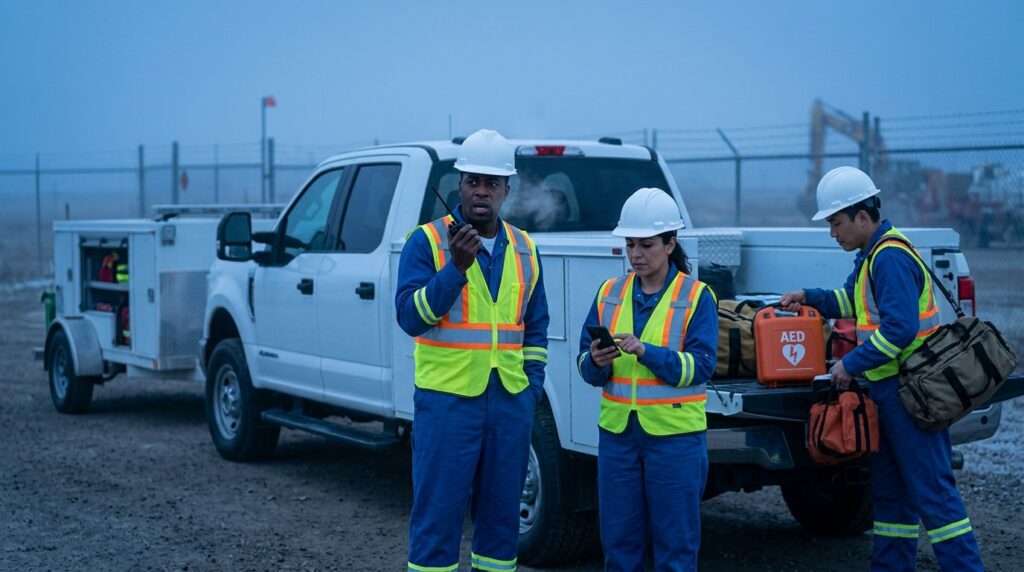
Rapid-response HSE team of three professionals in FR coveralls and high-visibility vests at a remote wellsite gate at dawn, unloading an AED, medical gear, and safety equipment from a crew-cab pickup truck and medical unit trailer.

Emergency HSE Staffing: How to Deploy Qualified Safety Personnel in 48 Hours

Emergency HSE staffing situations happen more often than anyone plans for. A provider no-shows on mobilization day. A safety technician has a family emergency mid-project. An operator audit finds your HSE coverage inadequate and gives you 48 hours to fix it. A fast-tracked project kicks off two weeks ahead of schedule.

Why Emergency HSE Staffing Situations Occur

Provider failure is the most common cause. A staffing company commits to a mobilization date and misses it because they were recruiting after contract award rather than pulling from a pre-qualified bench. Project acceleration occurs when construction schedules move up and the HSE provider cannot compress their deployment process. Operator audit findings sometimes require immediate staffing increases. Mid-project personnel changes happen when a deployed safety technician leaves for any reason.

What 48-Hour Deployment Actually Requires

First, the provider needs a bench of pre-qualified personnel who are not currently deployed. Providers operating at 100 percent utilization have no bench capacity for emergency requests. Second, credential packages must be current and ready. A 48-hour timeline does not allow for renewed certifications, updated background checks, or new drug tests. Third, deployment logistics for the specific geographic region must be handled within the 48-hour window. Fourth, the deployed professional must be operationally effective on arrival, not just physically present.

How to Evaluate Emergency Staffing Capability Before You Need It

The time to evaluate a provider’s emergency capability is before you have an emergency. Ask specifically how many pre-qualified, non-deployed safety professionals they have available in your operating region. Ask for examples of recent emergency deployments with specific timelines. Some contractors maintain standing agreements with emergency staffing providers. A pre-negotiated rate and mobilization commitment that can be activated with a single phone call.

The Cost of Not Having Emergency Coverage

A project operating without required HSE coverage faces immediate compliance risk. If an incident occurs without a qualified safety professional on site, the liability and TRIR implications are severe. Crew idle time costs money directly. If work must stop because safety personnel are unavailable, every hour of idle crew time and equipment rental is a direct cost attributable to the staffing gap.

Frequently Asked Questions

Q: How fast can emergency HSE staffing be deployed?
A: Providers with pre-qualified bench personnel can typically deploy to established operating regions within 24 to 48 hours. Providers who need to recruit after receiving the request typically require one to two weeks.

Q: What should I do if my HSE provider no-shows on mobilization day?
A: Contact your backup HSE staffing provider immediately. Notify the operator and provide a replacement timeline. Do not allow work to proceed without required safety coverage.

Need qualified HSE personnel on site fast? Drake Group maintains pre-qualified bench personnel ready for 48-hour deployment across Gulf Coast, Permian Basin, and Appalachian operating regions. Contact us for emergency staffing availability.

Emergency HSE Staffing: How to Deploy Qualified Safety Personnel in 48 Hours Read More »

HSE advisor in high-visibility vest conducting a job hazard analysis with two craft workers at a petrochemical construction site, pointing out an overhead hazard near scaffolding during active work.

What Does an HSE Advisor Actually Do on a Construction Site?

An HSE advisor on a construction site is responsible for identifying and eliminating hazards before they cause injuries, ensuring the project complies with OSHA regulations and operator requirements, and creating the conditions where workers go home in the same condition they arrived.

The Morning: Pre-Task Planning and Hazard Identification

Before any tools come out, the HSE advisor reviews the day’s work scope and conducts or oversees pre-task hazard assessments, commonly called Job Safety Analyses or JHAs. Pre-task planning is not a formality. It is the primary mechanism for identifying hazards before work begins. The advisor walks the work areas, reviews planned activities against the site-specific safety plan, and identifies any conditions that have changed since the previous shift.

Throughout the Day: Safety Observations and Field Presence

The core of the HSE advisor’s day is spent in the field, not in a trailer. The most effective advisors approach observations as coaching opportunities. When they observe an at-risk behavior, they stop the work, discuss the hazard with the worker, and help them identify a safer approach. This coaching model builds safety awareness across the crew rather than creating a dynamic where workers hide unsafe practices when the safety person is watching.

Incident Response and Investigation

When an incident occurs, the HSE advisor ensures the injured worker receives appropriate medical attention, secures the incident scene, notifies the project superintendent, and initiates the incident investigation. A thorough investigation identifies root causes, the systemic factors that allowed the incident to occur. An HSE advisor who only documents what happened without identifying why it happened is not completing the investigation.

Compliance Documentation and Reporting

The less visible but equally important part of the role is maintaining compliance documentation: daily safety observation logs, incident and near-miss reports, permit-to-work documentation, equipment inspection records, and training documentation. This documentation is also the evidence base for your OSHA 300 Log entries and TRIR calculation.

Frequently Asked Questions

Q: What certifications does an HSE advisor need?
A: The most recognized certifications are CSP from the Board of Certified Safety Professionals and CHST for construction-specific positions. OSHA 30-hour training is a common baseline requirement.

Q: How many HSE advisors does a construction project need?
A: Common ratios range from one advisor per 50 to 75 workers on general construction to one per 25 to 40 on high-hazard operations. Operators may specify minimum ratios in their contract requirements.

Q: What safety certifications are required for oil and gas work?
A: Oil and gas projects typically require CSP or CHST, OSHA 30-hour training, H2S awareness, HAZWOPER certification, and PEC SafeLand or equivalent orientation training.

Need a qualified HSE advisor for your next project? Contact Drake Group for staffing availability.

What Does an HSE Advisor Actually Do on a Construction Site? Read More »

HSE manager completing OSHA incident recordkeeping at a dual-monitor workstation in a job site office, with an industrial facility visible through the window at dusk, hard hat and safety glasses resting on the desk.

OSHA Recordkeeping Requirements for Contractors: Avoiding the Most Common Mistakes

OSHA recordkeeping is the compliance requirement that every contractor knows about and a surprising number get wrong. The mistakes are rarely dramatic. They are subtle classification errors, missed recording deadlines, and log maintenance oversights that compound into citation exposure, ISNetworld findings, and inaccurate TRIR calculations.

Which Contractors Must Keep OSHA Records

OSHA recordkeeping requirements under 29 CFR Part 1904 apply to most employers. Employers with 10 or fewer employees are exempt from routine recordkeeping, but most oil and gas, pipeline, construction, and industrial services contractors exceed the 10-employee threshold. Even if your company qualifies for a partial exemption, operators require OSHA logs as part of their ISNetworld, Avetta, or direct prequalification requirements.

The OSHA 300 Log: What Must Be Recorded

A case is recordable if it results in death, days away from work, restricted work, medical treatment beyond first aid, loss of consciousness, or a significant injury diagnosed by a licensed healthcare professional. The distinction between first aid and medical treatment is where most classification errors occur. Prescription-strength medications, sutures, and physical therapy all constitute medical treatment that makes a case recordable.

Recording Deadlines and Log Maintenance

New cases must be entered on the 300 Log within seven calendar days. OSHA 300 Logs must be kept for five years following the year they cover. The 300A summary must be posted from February 1 through April 30 each year and must be certified by a company executive.

How Recordkeeping Errors Affect Your TRIR and ISNetworld

ISNetworld’s RAVS review process independently evaluates your OSHA logs, and discrepancies between your reported rates and the underlying log data trigger compliance findings. Under-recording creates citation exposure and ISNetworld audit risk. Over-recording inflates your TRIR relative to your actual safety performance.

Frequently Asked Questions

Q: What OSHA forms do contractors need to keep?
A: Most contractors must maintain the OSHA 300 Log, the OSHA 300A Summary, and the OSHA 301 Incident Report for each recordable case. These forms must be kept for five years.

Q: What is the difference between OSHA first aid and medical treatment?
A: First aid is a specific list of minor treatments. Any treatment beyond the first aid list, including prescription medications, sutures, and physical therapy, constitutes medical treatment and makes the case recordable.

Q: When do OSHA 300 Logs need to be updated?
A: New cases must be entered within seven calendar days. Electronic submission through the ITA system is due by March 2 for qualifying employers.

Need help ensuring your OSHA recordkeeping is audit-ready? Contact Drake Group for a compliance review.

OSHA Recordkeeping Requirements for Contractors: Avoiding the Most Common Mistakes Read More »

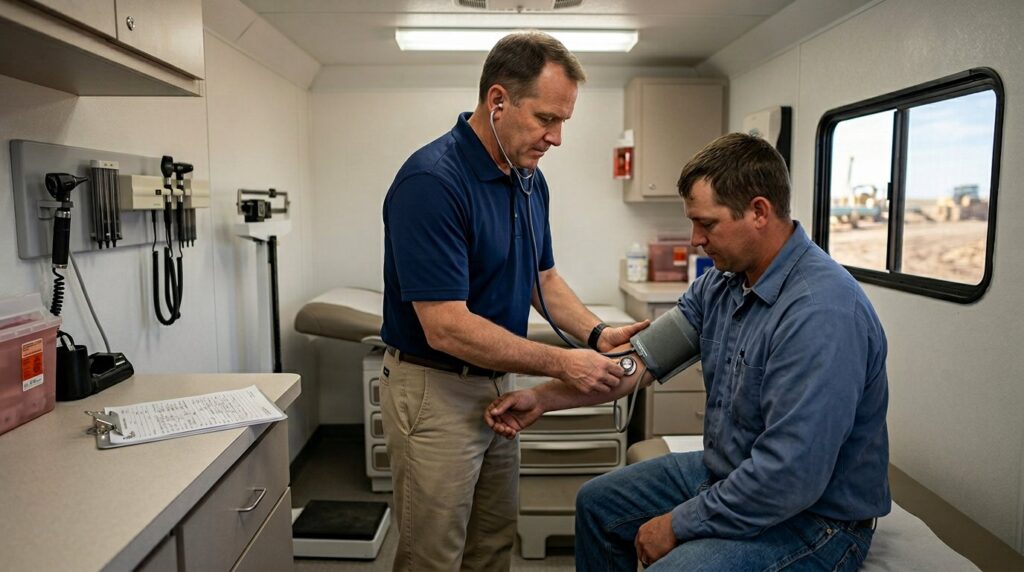
NRCME-certified medical examiner performing a DOT physical on a seated worker inside a mobile medical unit trailer at a remote pipeline project site, taking blood pressure with a manual cuff and stethoscope.

Pre-Employment Drug Testing and DOT Physicals: What Contractors Need to Know

Pre-employment drug testing and DOT physical examinations are foundational compliance requirements for contractors in oil and gas, pipeline, construction, and transportation. Getting them wrong creates immediate project access problems, regulatory exposure, and potential disqualification from operator work scopes.

DOT Physical Examination Requirements

The DOT physical examination is required for all commercial motor vehicle drivers under FMCSA regulations. The certificate is valid for up to 24 months. The critical compliance point: since 2014, DOT physicals must be performed by medical examiners listed on the FMCSA National Registry of Certified Medical Examiners. A physical performed by a provider not on the NRCME registry is invalid for DOT purposes, regardless of the provider’s medical qualifications. This is the single most common DOT physical audit finding.

NRCME Medical Examiner Requirements

Contractors should verify their medical provider’s NRCME listing before scheduling any DOT physical. The FMCSA maintains a public search tool where you can confirm a provider’s current registry status. Using a non-listed provider means every driver physical performed by that provider is invalid, which can cascade into driver qualification file deficiencies across your entire fleet.

Drake Group’s clinical operations team includes NRCME-certified medical examiners who can perform DOT physicals on site at project locations, eliminating the need for drivers to travel to off-site clinics.

Pre-Employment Drug Testing Requirements

For DOT-regulated positions, pre-employment drug testing must follow 49 CFR Part 40 procedures. The DOT five-panel test screens for marijuana, cocaine, opiates, amphetamines, and phencyclidine. For PHMSA-regulated pipeline operations, testing must be completed with a verified negative result before any individual performs a covered pipeline function. The most common pre-employment testing mistake is timing. Verify the acceptable testing window for each operator before assuming a previous test result remains valid.

Audiometric Testing and Hearing Conservation

Contractors with employees exposed to noise levels at or above 85 decibels over an eight-hour time-weighted average must implement a hearing conservation program under OSHA 29 CFR 1910.95. Audiometric testing must be performed by a CAOHC-certified technician or a licensed audiologist. Drake Group’s clinical team includes CAOHC-certified technicians who can conduct audiometric testing on site.

Frequently Asked Questions

Q: Who can perform a DOT physical examination?
A: DOT physicals must be performed by a medical examiner listed on the FMCSA National Registry of Certified Medical Examiners. Physicals performed by non-NRCME providers are invalid for DOT purposes.

Q: What does a DOT drug test screen for?
A: The DOT five-panel drug test screens for marijuana, cocaine, opiates, amphetamines, and phencyclidine. Testing must follow 49 CFR Part 40 procedures using SAMHSA-certified laboratories.

Q: Can DOT physicals be done on site at project locations?
A: Yes, if the on-site medical provider holds current NRCME certification. Drake Group provides NRCME-certified examiners as part of its on-site medical staffing services.

Need on-site DOT physicals, drug testing, or audiometric services? Contact Drake Group for medical staffing capabilities.

Pre-Employment Drug Testing and DOT Physicals: What Contractors Need to Know Read More »
Client project manager shaking hands with an HSE services contractor at a refinery gate at golden hour, with a credentialed multi-discipline safety and medical team standing by with gear bags ready to deploy.

What to Look for in an HSE Staffing Partner for Oil and Gas Projects

The HSE staffing partner you choose for oil and gas projects directly determines your safety performance, compliance posture, and ability to meet operator prequalification requirements. A strong partner strengthens your TRIR, simplifies ISNetworld compliance, and deploys qualified personnel fast enough to keep your project on schedule.

Why HSE Staffing Decisions Matter More in Oil and Gas

Operators set explicit TRIR and DART thresholds for contractor prequalification. ISNetworld scores are visible to every potential client reviewing your profile. And a single serious incident on a high-profile project can affect your bidding eligibility across an entire basin. The difference between a qualified HSE staffing partner and a generic staffing agency is not a matter of preference. It is a matter of business continuity.

Credential Depth Across Disciplines

Safety professionals should hold CSP, CHST, or OHST certifications from the Board of Certified Safety Professionals. Medical staffing should include NRCME-certified medical examiners for DOT physicals, CAOHC-certified technicians for audiometric testing, and personnel with case management credentials for return-to-work programs. Environmental personnel should understand SPCC plan requirements, stormwater management, and air quality monitoring for H2S and VOC exposure.

The Integration Advantage

When an incident occurs on site, the safety technician, medical provider, environmental response team, and security personnel all need to operate from the same emergency action plan. If they work for four different companies with four different reporting structures, coordination failures are not a possibility. They are a certainty. Integrated HSE providers deliver all four disciplines under a single contract with a unified chain of command.

Rapid Deployment and Bench Depth

Evaluate providers on their bench depth: the number of pre-qualified, pre-credentialed personnel available for immediate deployment. A provider who needs to recruit for your position after you award the contract is a provider who will delay your project. Ask about deployment logistics for your specific operating area. Geographic alignment between the provider’s available personnel and your project location is critical.

Contract Flexibility and Red Flags

Red flags to watch for: a provider who cannot tell you which certifications their personnel hold without checking does not have a credential management system. A provider who refuses to share ISNetworld or Avetta scores likely has compliance issues they are not disclosing. A provider who cannot produce references from comparable projects within the past 12 months may not have the relevant experience they claim.

Frequently Asked Questions

Q: What does HSE staffing include for oil and gas?
A: HSE staffing for oil and gas typically includes safety technicians and managers, occupational health and medical personnel, environmental compliance specialists, and industrial hygienists. Comprehensive providers also include site security and emergency response personnel.

Q: Can one provider handle medical, safety, and environmental?
A: Yes. Integrated HSE providers deliver medical staffing, safety oversight, environmental compliance, and site security under a single contract. Not all providers offer true integration, so verify their capability across all required disciplines.

Looking for an integrated HSE staffing partner? Contact Drake Group for a capabilities overview.

What to Look for in an HSE Staffing Partner for Oil and Gas Projects Read More »

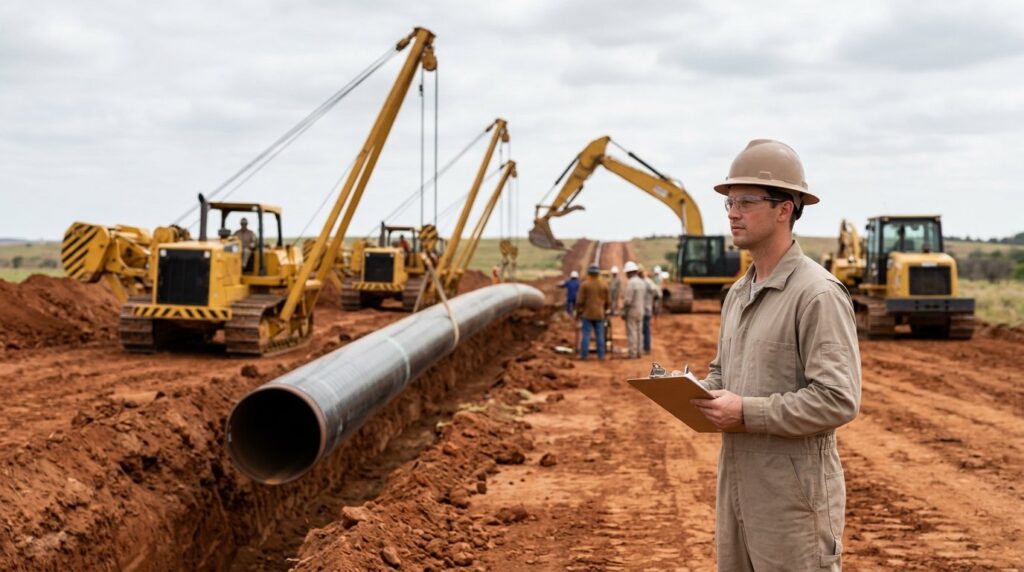
DOT-qualified pipeline safety observer in FR coveralls with clipboard standing alongside an active pipeline construction right-of-way, with sidebooms lowering coated steel pipe into a trench in red-clay terrain.

DOT Compliance Checklist for Pipeline Construction Contractors in 2026

DOT compliance for pipeline construction contractors covers a specific set of federal requirements under PHMSA and FMCSA regulations. Missing any single element can result in project shutdowns, operator penalties, and contractor disqualification from future work.

Pre-Project Documentation Requirements

Operator qualification records must be current under 49 CFR Part 192 for gas pipelines and Part 195 for hazardous liquid pipelines. Every individual performing covered tasks must have documented qualification for each specific task. Qualification is task-specific, not role-specific.

Drug and alcohol program documentation must demonstrate compliance with 49 CFR Part 199 for pipeline operators and Part 40 for testing procedures. Damage prevention plans must comply with state one-call requirements and federal requirements.

Driver Qualification File Requirements

Every CMV driver must have a complete Driver Qualification file under FMCSA Part 391. Required elements include a completed employment application going back 10 years, motor vehicle records, road test certificate, annual driving record review, and a medical examiner’s certificate from an NRCME-listed provider.

The NRCME requirement is the most common audit finding. Certificates from non-listed providers are not valid for DOT purposes.

Hours of Service Rules on Pipeline Projects

The standard rules limit property-carrying CMV drivers to 11 hours of driving after 10 consecutive hours off duty, with a 14-hour on-duty window. Pipeline construction projects may qualify for certain exemptions, but assuming an exemption applies without verifying the criteria is a common compliance failure. Electronic logging devices are required for most CMV operations.

Drug and Alcohol Testing Requirements

Random testing must be conducted at the minimum annual rates set by PHMSA: 50 percent for drug testing and 10 percent for alcohol testing. All testing must use certified laboratories and follow DOT-specified chain-of-custody procedures under Part 40.

The Cost of Non-Compliance

FMCSA civil penalties can reach over $16,000 per violation. PHMSA penalties for pipeline safety violations can exceed $200,000 per violation per day. Beyond direct penalties, non-compliance creates cascading consequences including project suspension and ISNetworld compliance findings.

Frequently Asked Questions

Q: What DOT regulations apply to pipeline construction?
A: Pipeline construction contractors must comply with PHMSA regulations under 49 CFR Parts 192 and 195, FMCSA regulations under Parts 382, 383, 391, 395, and 396, and Part 199 for drug and alcohol testing.

Q: What is operator qualification for pipeline work?
A: Operator qualification requires that every individual performing a covered task be specifically qualified for that task through evaluation, training, and documentation. Qualification is task-specific.

Need DOT compliance support for your pipeline project? Contact Drake Group for comprehensive DOT compliance services including NRCME-certified medical examinations.

DOT Compliance Checklist for Pipeline Construction Contractors in 2026 Read More »

Contractor compliance coordinator working at a laptop in a job site office trailer, managing ISNetworld and Avetta prequalification documentation with file folders, notebook, and hard hat nearby.

ISNetworld vs Avetta vs Veriforce: What Operators Actually Require

ISNetworld, Avetta, and Veriforce are the three dominant contractor management platforms used by operators in oil and gas, pipeline, mining, construction, and energy. Each platform collects and verifies contractor safety data, insurance documentation, and compliance records, but they differ in how they score contractors, what documentation they require, and which operators mandate which platform.

What ISNetworld Requires

ISNetworld is the most widely used contractor management platform in North America, particularly in oil and gas and petrochemical operations. Core requirements include your OSHA 300 logs and incident rates for the past three years, your Experience Modification Rate, a written health and safety program, insurance certificates, and employee training records. ISNetworld assigns a grade to each submitted element. Maintaining an A or B grade across all categories is effectively required to remain eligible for work with most major operators.

What Avetta Requires

Avetta serves a broader industry range than ISNetworld, with strong adoption in construction, manufacturing, utilities, and mining. Avetta uses a compliance scoring system that evaluates your documentation against the specific requirements set by each operator you connect with. One notable difference is that Avetta’s operator-specific requirements can vary more widely than ISNetworld’s standardized RAVS categories.

What Veriforce Requires

Veriforce is heavily used in pipeline operations and is the dominant platform for DOT-regulated contractor prequalification. Veriforce focuses heavily on operator qualification records under 49 CFR Part 192 and 195, drug and alcohol testing program compliance, and safety performance metrics specific to pipeline operations. Qualification records must be maintained at the individual employee and task level.

Managing Compliance Across All Three Simultaneously

The most efficient approach treats the three platforms as variations on a single compliance program. Build your safety management system and documentation standards to the highest common denominator across all three. Designate a single compliance coordinator responsible for all three platforms. Maintain a master document library and update all three platforms simultaneously when documents change.

How Your HSE Staffing Partner Affects Platform Compliance

Your HSE staffing partner’s compliance status on these platforms directly affects your own compliance profile. Before engaging any HSE staffing partner, verify their current compliance status on every platform your operators require. Ask for current scores, not just confirmation of enrollment.

Frequently Asked Questions

Q: Do I need ISNetworld and Avetta and Veriforce?
A: It depends on which operators you work for. Pipeline contractors almost always need Veriforce. Oil and gas contractors typically need ISNetworld at minimum, with Avetta required by certain operators.

Q: What is the difference between ISNetworld and Avetta?
A: ISNetworld uses a standardized RAVS grading system and is dominant in oil and gas. Avetta uses operator-specific compliance scoring and has broader industry adoption.

Q: How do I improve my ISNetworld score?
A: Focus on updating your written safety program, ensuring OSHA 300 logs are complete, verifying insurance certificates meet all operator minimums, and uploading current training records.

Need help maintaining compliance across all three platforms? Contact Drake Group for a compliance capabilities overview.

ISNetworld vs Avetta vs Veriforce: What Operators Actually Require Read More »

Scroll to Top